Navigation

Monday, January 27, 2020

Friends of Camp Unity - January Update: Join the Board, Winter Weather Needs and Other Updates


Camp Unity Eastside is now [as of January 27, 2020] located at St. Teresa of Calcutta Catholic Church, 17856 NE Woodinville Duvall Rd.  

THANK YOU to the 24+ volunteers who helped move the camp, brought meals during the move, Bear Creek United Methodist Church for hosting camp since mid-September and St. Teresa Church for hosting again starting this month.    What a difference you make in the lives of so many people.

Join the Camp Unity Board:   Camp Unity has a volunteer board that supports camp operations, oversees camp management, and meets once a month.  The Board is seeking one or more additional members as well as a volunteer to lead Camp Unity’s collaboration with prospective new hosts and recent hosts.   If you or someone you know might be interested in volunteering as a board member or leading Camp Unity’s host outreach, please contact Mark Van Wormer.   

Karen Tidball, who served on the Board for more than 5 years and led the site committee, stepped down in January due to family reasons.  Thanks to Karen’s dedication and collaboration with our generous hosts, Camp Unity had a full year of host commitments at the start of 2019 for the first time.   We’re forever grateful to Karen for the love, wisdom and compassion she brought to everything she did for Camp Unity and its residents.

Winter Weather Needs:   The past few weeks of wet, cold weather and limited light have been challenging.   We’re grateful for any help you can provide to Camp Unity with any of the following winter weather needs:
  • Wool Blankets (similar to military issue)
  • Head lamps
  • Rain paints – for men, sizes XXL, XL and L and for women, sizes XXL, XL and L
  • Containers of durable water repellant  (such as spray on type)
  • Sample carpets that can be placed on the floor of individual tents:  the tent floor size is 7.6’ by 8.6’ so either a piece similar to that in size or a few pieces that can be laid out
This is a great opportunity for a service project with others at work,  church or other faith community, or club.   If you can help, please bring donations to the camp at St.  Teresa Church. Shout out to Woodinville Church of Christ for seeking donations at their church for socks, rain jackets and hand warmers! 

Meals:   We’re so thrilled that volunteers have brought meals every day in January after the camp’s move and almost every day prior to the move.   Thank you!!   Looking ahead, there are several openings in February and March.  If you can help, please sign up on the camp's meal calendar  OR   https://campunityeastside.com/meals-2/  

Not enough time to cook?   Consider picking up and heating prepared food – such as 4 large Costco chicken pot pies are enough to feed the camp.   There are 21 people staying at Camp Unity and during the past month, one additional resident has moved to housing.  

Supply Needs:  Camp Unity greatly appreciates all who have brought supplies to the camp.   Currently, the highest priority supply needs are paper towel rolls, coffee (ground), AA and AAA batteries.  Please bring donations to the camp at St.  Teresa of Calcutta Catholic Church. For more info and the latest updates, check out Camp Unity’s needs list.   OR   https://campunityeastside.com/camp-essential-needs/  

December Reflections:  We’re deeply grateful to the individuals and churches, including Northshore United Church of Christ, Wooden Cross Lutheran Church and Woven Church, that made a year end gift to Camp Unity Eastside.  Your generosity enables Camp Unity to continue to provide shelter for people in need.

We’re also very thankful to the churches and others who helped to make the Christmas holiday special for residents at Camp Unity through gifts and supplies via giving trees and other initiatives.  A big thank you to Bear Creek United Methodist Church, Lighthouse Four Square Church, St. Teresa of Calcutta Catholic Church, Woven Church, Flex Physical Therapy Bothell and any other supporters we may not be aware of!

Your care and generosity are huge blessings for the men and women staying at Camp Unity.

Wednesday, March 20, 2019

March 2019: What's new with GSC?

What makes snow beautiful to us? I often wonder whether we would find it so pretty if we weren’t able to get warm and dry. During the recent snow event, at Tent City 3, many tents collapsed, including the supply tent. Campers doubled up with friends, or stayed in the dormitory tents, and some had to move out entirely. Vital supplies were buried under sheets of ice. It was days before enough snow could be removed, damaged assessed, and the camp reset itself. Your caring and contributions are what allow us to speed up recovery from such disasters and get folks warm and dry again.

With your contributions, we continue to regularly support Tent City 3, Camp United We Stand, and Tent City 5 with items needed on a daily basis like trash bags, hand sanitizer, gas for generators, batteries, food, clothing, blankets, and office supplies. We also supply camp infrastructure including tents, tarps, microwaves, coffee makers, plywood, pallets and move supplies.

Through gleaning we occasionally receive and pass on bedding, battery chargers, clothing, laundry soap, toiletries and other items. More often though, we meet urgent and basic needs through the funds provided by our donors. Gleaned items that the encampments can’t manage such as sacks of raw rice and beans are routed to various food banks and shelters. Through gleaning we take items that would be thrown away and provide them to people who can really use them. This reduces waste for local retailers and allows store employees to participate in making a difference in people’s lives.

Tent City 3 continues to shelter a few younger children in residence who need diapers and warm clothing. During the warmer, drier months we would see one young boy riding a little toy car up and down the ramp in front of the camp’s front desk. This week his mother is just trying to keep him dry and warm.

Over the next few weeks, and even months, we will be working hard to replace damaged tents, to repair winter damage, and to bolster camp facilities against the coming spring storms. Please consider helping us in this effort with a donation today. Visit http://greaterseattlecares.org/ and select “Donate Today.” Donations can also be mailed to PO Box 77815, Seattle, WA 98177-0815. Thank you for your heart to help those experiencing homelessness, and we hope you will stay in touch with us.

Camp United We Stand at Haller Lake UMC


Sincerely,
Elizabeth Hinkofer,
Secretary, Greater Seattle Cares

Sunday, February 17, 2019

Please Help with Camp Unity's Move - March 1 and 2


It’s time again on March 1 and 2 to move Camp Unity Eastside!  We depend on volunteers like you to help us in packing, moving and setting up the community and personal tents, platforms, and camp supplies.  Won’t you join us?   It’s a great opportunity to meet and work along side men and women of the camp and other volunteers in the community.  See below for more info on ways to help with the move, needed supplies and meals.
Move Essentials
  • Current camp location: 17401 133rd Avenue NE, Woodinville.  Next to the Carol Edwards Center on the Woodinville City Hall campus
  • New camp location: St. Jude Parish, 10526 166th Avenue NE, Redmond

Day
Tentative Schedule and Logistics
Friday, March 1
8:30 am to 5 pm:  Planned start is at St. Jude Parish, Redmond.  Focus will be on unloading trucks and setting up community tents and platforms.
Saturday, March 2
8 am start, duration to be determined: Planned start is at the Woodinville site to pack up and move any remaining items and finish site clean-up, and then complete camp set up at St. Jude Parish site

Let Us Know You Can Join

We’ll update you on move logistics including updates for start times and locations

What to Bring
  • Wear clothes you don’t mind getting dirty, sturdy shoes, gloves, and rain gear if needed
  • Tools:  We need several cordless drills, Phillips head bit size #2 and fully charged batteries
  • Bring personal water and snacks.  Lunch will most likely be provided.
  • Trucks and trailers are greatly appreciated
  • Kids are welcome

Want to Help By Providing Supplies or a Meal?
  • Provide supplies from the needs list for the move such as zip ties, duct tape and work gloves.  Please bring donated supplies to Camp Unity in Woodinville by February 25.
  • Provide a breakfast, lunch or dinner during the move. Email Lori for more info if you can help.

Thank you for helping the men and women of Camp Unity in this tremendous way!

Thursday, May 3, 2018

Camp moves, immediate needs and more

What’s New?

Camp Moves

Tent City 3 is moving this weekend to the “Church by the Side of the Road, “located at 3455 S. 148th St. Tukwila WA 98168.
Camp United We Stand is planning to move from St. Dunstans in Shoreline to the George Center starting on May 18th. The George Center is located at 2212 NE 125th Street, Seattle WA 98125. UWS will move to the Haller Lake United Methodist Church in August.
 The St. George location does not have power or water so camp UWS will need support with those items once they move. We do not know whether TC3 will have access to power and water in Tukwila.

What’s not new?

Moving Again

Both Tent City 3 and Camp United We Stand are moving soon. Moving a camp is a lot of hard work. Imagine having to pack up everything you own, dismantle your house drag it across town, rebuild it and reset up all your belongings. Add to that having to rebuild all the surrounding community infrastructure on which you depend. This is the case almost every 12 weeks for these camps and includes the camps front desk and office, the kitchen, the donations tent and the dormitories. During the time it takes to accomplish the move the campers are completely outside so rain, cold or in some cases extreme heat can take its toll on them especially anyone in fragile health.
Greater Seattle Cares checks with the camps to provide the supplies needed for the camp move such as garbage bags, hammers, nails, work gloves, gorilla tape zip ties and brooms. A move kit with all these items can cost $300 for small camps and more than $500 for the larger camps. We have at times rented trucks to help with the moves and always check to make sure the campers have meals and water in both the location they are moving out of and the one they are moving in. The campers always appreciate volunteers. Please stop by and give them a hand, bring them some water, food or let us know if you would like to make a donation to support their moves. If you bring food or water to be mindful of any trash that will be generated as the camp will have to dispose of that.

Tents - While some of the sanctioned encampments use tiny houses, camps Tent City 3 and United We Stand still live in tents. These tents were designed for recreational, not continuous use so typically last only about 10 to 12 months. UV damage weakens the tent fabric over time. This means that there is almost a constant need for new tents.
The camps cycle out the tents that are aging as they wear. The tents are typically covered with a tarp to prolong the life of the tent and to prevent leaks along the seams. The camps set up their tents on platforms that are most commonly built of pallets covered with plywood. This is necessary to keep the tent out of water during rain. Using pallets makes the tent foot print a standard in size. Typically single person tents are 8’ X10’ and those for doubles are 10’ X 12’. Cabin style tents are preferred so that people can stand up inside and because they provide more usable room inside. A single tent can cost anywhere from $50 to $80 each and the doubles can cost from $140 to $250 each. Our GSC Board recently purchased 4 single tents for both camp UWS and TC3.
As the weather warms up, the populations in the sanctioned camps typically rises so their will undoubtedly be a need for additional tents. Please consider adopting a tent or donating funds for that purpose. Perhaps there are groups that might like to fund raise for tents specifically. Our board would be happy to help you facilitate, so just let us know if we can help.

What are current needs?

Water- When a camp doesn’t have water access they need bottled water or water jugs. Our recommendation is to fill the camps large water containers rather than supplying individual bottles of water. Individual plastic bottles create a lot of garbage that the camp then has to dispose.
Gas for the Generators- Tent City 3 is using generators at their current location and UWS will need to do the same when the move to the George Center. They typically need donations of gasoline to keep them going. We recommend picking up the gas cans and taking them to be filled as they are heavy to carry and the campers typically don’t have transportation.
Clothing- Keep in mind that a lot of campers are larger men. New undergarments are always appreciated but everything helps.
Blankets and Bedding- Campers need bedding and the ability to wash it. Each camp has its own laundry arrangements, but they sometimes need assistance with obtaining these donations
Batteries-Camps without power will rely on battery operated flashlights and other items.

Current Camp Hosts and Locations

Tent City 3-Cherry Hill Baptist Church, 700 22nd Ave. Seattle, WA 98122
United We Stand-St. Dunstans Church, 722 N 145th St, Shoreline, WA 98133
Tent City 4-Public Property in Issaquah, Exit 20 on I-90, Issaquah, WA
Tent City 5-Interbay Neighborhood in Ballard, 1601 15th Ave. W (cross street Garfield, under the Magnolia Bridge), Seattle, WA 98119
Camp Lichton Springs-Private Property belonging to the Low Income Housing Institute, 8620 Aurora Ave N just south of Seattle Fabrics
Camp Unity Eastside-Bear Creek United Methodist Church, 16530 Avondale Rd NE, Woodinville, WA 98077
Camp Second Chance-Public Property in White Center, 9625 Myers Way S. Seattle, WA 98108
Nicklesville Othello-7544 Martin Luther King Jr. Way, Seattle, WA
Nicklesville Union-Lutheran Church of the Good Shepherd, 22nd and E Union, Seattle, WA
Nickelsville Georgetown-1000 S. Myrtle St., Seattle, WA

Thank you!

Thank you for participating in the mission of Greater Seattle Cares. Thank you for caring! And thank you for your donations of money, time, goods, and relationships. Your caring brings hope and change to those we serve.

Friday, March 2, 2018

February 2018 Updates

What’s New?

Camp Moves

We are happy to report that Camp United We Stand has had their stay at St. Dunstan’s church in Shoreline extended until May. The will move to the Haller Lake United Methodist Church in August but are still searching for a host for May, June and July. Tent City 3 moved last weekend to a site owned by Cherry Hill Baptist Church in the old central district. Their new home has neither power nor water access, but we are grateful for it as the location was not found until the last minute before they were due to leave SPU and it had looked like they might not have a place to go.

What’s not new?

Site Searches

The camps we support have needs that are constant. Chiefly, they need a place to stay. The sanctioned camps we support typically, have to move every 90 days depending upon the type of permit needed for the host location. While the occasionally may be able to stay longer they typically have to find 4 hosts a year or risk having to move to an illegal location where they could be subject to being swept. The one constant need is space. Depending upon the size of the camp the amount of space needed can vary. Ideally the space should be fairly flat but even that is not an absolute requirement as we have seen tent bases adjusted to compensate for different sites. It is preferred they have access to power and water, but they have generators and water jugs if that is not the case. While Greater Seattle Cares does not manage host searches for any of the camps we do reassure prospective hosts that we will provide services to the camps assisting with food and supplies during their stay and if needed support with moving in or leaving. If you are aware of any church, school or private business that may be interested in becoming a host please contact the camp or SHARE WHEEL directly with your lead. 90 days may sound like a long time but the reality is that the search for host locations goes on constantly.

What are current needs?

Managing donations - When delivering items to camp please always take care not to overload them. While the campers are always grateful if the camp receives more than it can use it can create problems. Items stored in tents can become damp and moldy. If you are delivering to camp, always ask for the donation coordinator or for food donations, the kitchen coordinator. Ideally call ahead and check with the camp to ask them what is needed and how many people currently reside in camp. The camp phone numbers can be found on our website.
Food for the Pantry - GSC recently delivered some individual ready to eat foods to Tent City 3 as their pantry was almost completely wiped out after their move.
Water - When a camp doesn’t have water access they need bottled water or water jugs. Our recommendation is to fill the camps large water containers rather than supplying individual bottles of water. Individual plastic bottles create a lot of garbage that the camp then has to dispose.
Gas for the Generators - We assume Tent City 3 will be using generators at their current location. They typically need donations of gasoline to keep them going. We recommend picking up the gas cans and taking them to be filled as they are heavy to carry and the campers typically don’t have transportation. Last year when staying at Skyway GSC purchased gas for the camp on a weekly basis.
Tents and Tarps - A tent used year round only lasts about a year. Camps use what the call singles and doubles which can range in price from $50 to $150 each. The can also use tent carports for common use tents and like cabin style tents so someone can stand up inside. Tarps extend the life of the tents by protecting the seams and keep the tent much drier.
Coats and warm clothing - Any cold weather clothing we can provide, especially is a blessing this time of year. Keep in mind that a lot of campers are larger men. New undergarments are always appreciated.
Blankets and Bedding - Campers need bedding and the ability to wash it. Each camp has its own laundry arrangements, but they sometimes need assistance with obtaining these donations
Batteries -The short days mean more flashlights will be used and that means batteries. Especially for Tent City 3 as their new site does not have power.

Current Camp Hosts and Locations

Tent City 3 - Cherry Hill Baptist Church, 700 22nd Ave. Seattle, WA 98122
Tent City 4 - Mary Queen of Peace, 1121 228th Ave SE, Sammamish, WA 98075
Tent City 5 - Interbay Neighborhood in Ballard, 1601 15th Ave. W (cross street Garfield, under the Magnolia Bridge), Seattle, WA 98119
Camp Unity Eastside - Saint Teresa of Calcutta, 17856 NE Woodinville Duvall Rd, Woodinville WA 98077
Camp United We Stand - St. Dunstans Church, 722 N 145th St, Shoreline, WA 98133
Camp Second Chance - Public Property in White Center, 9625 Myers Way S. Seattle, WA 98108
Nicklesville Ballard - Public property in Ballard, NW Market Street, Seattle, WA
Nicklesville Othello - 7544 Martin Luther King Jr. Way, Seattle, WA
Nicklesville Union Tiny House Village - Lutheran Church of the Good Shepherd, 22nd and E Union, Seattle, WA
Nickelsville Georgetown - 1000 S. Myrtle St., Seattle, WA
Licton Springs Village - Private Property belonging to the Low Income Housing Institute, 8620 Aurora Ave N just south of Seattle Fabrics

Anatomy of a Camp Move:

Many of the camps we serve have to move about 4 times a year.  The move process takes a lot of planning, and hard work.  Imagine picking up everything you own, including your house and moving it across town every three months. 
Prior to a move, a camper with experience is designated as the “Move Master.” This person will coordinate all of the work involved with moving as well as gathering needed supplies.  GSC includes move supplies as a part of our budget. These can run about $400 per move and includes items like trash bags, zip ties, gorilla tape, and hammers, nails work gloves and brooms.  In some cases we have also rented vans and supplied a driver. Prior to the move, the move master will plot out the new camp layout to make sure everything needed will fit at the new site.  Before move day the camp may try to stage a few items at the new location. 
On move day there is a crew breaking down the camp at the old site and another stationed at the new site setting up.  All campers are required to participate in the move or will be barred for a time from the camp if they do not participate.  During the move trucks are loaded and as each arrives at the new camp site they are unpacked.
Common use tents such as the kitchen and Front Desk tents are set up prior to any individual tents.  The perimeter privacy screen is erected.  Usually dump runs are needed and if it is available electrical cords are set up to run the camp’s microwave and coffee maker.   Due to the physical work required with the moves GSC also tries to make extra sure there are meals provided in both locations. Volunteers and friends who want to help with the move are always welcome. Next time one of our camps move, we encourage stopping by to lend a hand.  While it appears our camps move in one day it really takes a good couple of weeks to get really settled.

Thank you!

Thank you for participating in the mission of Greater Seattle Cares. Thank you for caring! And thank you for your donations of money, time, goods, and relationships. Your caring brings hope and change to those we serve.

Friday, January 19, 2018

January 2018 Updates

Greater Seattle Cares: What’s New?

Our GSC Board

We are excited to introduce two new Board Members. Alice Marshall is our new Board president and brings many years of experience working with non-profit organization and a whole host of administrative skills. In addition, Carola von Wrangel has joined our board. Carola also works extensively with an organization called “Food for the Poor,” that provides relief and development aid to hungry people, mainly in the Caribbean. Both Alice and Carola have been volunteering with the St. Dunstan’s meal program providing a weekly meal to camps TC3, TC5, and UWS as well as a Community meal and have developed relationships with many of our volunteers and campers. You can see pictures and read more about all the board members on our website.
We would like to thank Frances Posel and Roger Franz for their service to us. Both have provided wise guidance and we will truly miss their presence on our board.
Cindy Roat, our former president still remains in the organization with her passion to serve those experiencing homelessness. She is already drafting proposals for Greater Seattle Cares activities this year. Cindy in many ways has been our heart and soul and she continues to support GSC and all our campers.

Greater Seattle Cares: What’s not new?

With the changes to our board, the thing that has not changed is our mission to provide relief to those experiencing homelessness through providing camp infrastructure, food, supplies, access to health services and most importantly, by building friendships. If you google “Greater Seattle Cares” the following statement appears: “Greater Seattle Cares envisions a world without homelessness…” May it be so!

Greater Seattle Cares: What are our current needs?

With the drop in temperature and the recent wind and rain storms, we need to focus on cold weather needs.
Camp United We Stand Move - UWS has moved to St. Dunstan’s in Shoreline as of November 18th. Stop by and say hello or lend a hand if you are able.
Tents and Tarps - A tent used year round only lasts about a year. With Cindy Roat’s help, we are working on a schedule and budget for replacing tents as they wear out. Recently, GSC provided nine new tents to Tent City 3, but we know all the camps will be needing tents, especially during the cold weather. In addition to the tents, in order to protect the tent and to avoid leaks, durable tarps are also needed. Some of the camps are also experimenting with using canopies over the tents. The tents also sit on pallets that are covered with plywood. Once soaked through, that plywood and pallets do not last many months.
Coats and warm clothing - Now that it is cold, any cold weather clothing we can provide, especially coats, is a blessing. Keep in mind that a lot of campers are larger men. New undergarments are always appreciated.
Blankets and Bedding - It is also important to make sure the campers have ample bedding and the ability to wash it. Each camp has its own arrangements, but they sometimes need assistance with obtaining these donations. They also need occasional help with transportation to the laundry facilities and with funds to wash the bedding.
Batteries -The short days mean more flashlights will be used and that means batteries.

Current Camp Hosts and Locations

Tent City 3 - Seattle Pacific University, McKenna Hall, between W. Bertona St. and W. Nickerson St, Seattle
United We Stand - St. Dunstans Church, 722 N 145th St, Shoreline, WA 98133
Tent City 4 - Mary Queen of Peace 1121 228th Ave SE, Sammamish, WA 98075
Tent City 5 - Interbay Neighborhood in Ballard, 1601 15th Ave. W (cross street Garfield, under the Magnolia Bridge), Seattle, WA 98119
Licton Springs Village - Private Property belonging to the Low Income Housing Institute, 8620 Aurora Ave N just south of Seattle Fabrics
Camp Unity Eastside - Saint Teresa of Calcutta 17856 NE Woodinville Duvall Rd, Woodinville WA 98077
Camp Second Chance - Public Property in White Center, 9625 Myers Way S. Seattle, WA 98108
Nicklesville Othello -7 544 Martin Luther King Jr. Way, Seattle, WA
Nicklesville Union - Lutheran Church of the Good Shepherd, 22nd and E Union, Seattle, WA
Nickelsville Georgetown -1 000 S. Myrtle St., Seattle, WA

A Personal Reflection:

Carola von Wrangel

Our news is full of stories of homelessness, generally with the heading of “what are we going to do about the homeless situation in the Seattle area?” After New York City and Los Angeles, Seattle has the third largest homeless population. As much as it is an honor to work with GSC serving the needs of the homeless, those needs and the stories seem almost overwhelming.
Every Tuesday I serve in the Community Dinner program at St. Dunstan’s Episcopal Church. We glean, cook and feed over 400 people each week, including providing for several encampments served by Greater Seattle Cares. On a recent Tuesday, one of the people we serve came to me with his story: He is employed, and technically not homeless. But he pays $2000 per month for his motel room, leaving no money for food, so the hot meals he receives are such a blessing. He repeated: “SUCH A BLESSING! THANK YOU!” The man is unable to pay first and last month rent plus security deposit to get into an apartment. And as we know, rents in the greater Seattle area are prohibitive. This man stays one step ahead of homelessness because of people who care, who donate, and who serve. Carola has come to Greater Seattle Cares by way of assisting one of many programs supported by our gleaners. Our gleaners ferry thousands of goods to the camps we support, as well as programs supporting those on the verge of homelessness. These gleaned goods would otherwise be disposed of.

Thank you!

We thank you for participating in the mission of Greater Seattle Cares. Thank you for caring! And thank you for your donations of money, time, goods, and relationships. Your caring brings hope and change to those we serve. For more information please visit us on the web. Greater Seattle Cares.

PO Box 77815, Shoreline WA, 98177

Wednesday, July 26, 2017

On a Mission

By Christy Houghton 
Christopher Carter
On a chilly Sunday morning last spring, I sat down with Christopher Carter, one of the residents at Camp United We Stand (CUWS). After graciously agreeing to the interview, he led me to the TV Tent so he could warm his hands by the heater while we talked.
Christopher has been an elected leader at the homeless camp, and speaks with sincerity and conviction. One of the first things I learn about him is that he’s on a personal mission.

“God Delivered Me from a Terrible Stutter” 

Christopher said he’d had a bad stutter for most of life. He worked in construction as a general contractor, building houses in Oklahoma. In 2013, a traveling evangelist sent him a text, telling him to read Jeremiah 33:3. At this point, Christopher paused, and I looked at him questioningly. He just repeated, “Jeremiah 33:3.” He went home and read the whole chapter.
When Christopher went to share what he'd read with his friend Theresa, she interrupted him, saying, "Christopher, you don't stutter no more." From that time on, Christopher says, “God delivered me from a terrible stutter, and has given me a beautiful voice.” It made his mother cry, when he first spoke to her without that stutter.
I didn’t learn what was in that Bible verse until I got home and looked it up. “Call to me and I will answer you and tell you great and unsearchable things you do not know.” – Jeremiah 33:3

He Needed to Go to Tent City 3 

In 2015 Christopher helped a friend of his move from Oklahoma to Arlington, Washington. From there, he felt called to go to Santa Monica, California. The police picked him up on the side of the Interstate, telling him that he couldn't walk down it. You can do that in some other states, but not in Washington. In Downtown Seattle, where the police dropped him off, Christopher had planned on getting a couple day’s work for a bus ticket to Santa Monica.
Someone he’d recently met at the Bread of Life Mission downtown interrupted a conversation with someone else not just once, but three separate times, to tell Christopher that he needed to go to Tent City 3. So, that’s what he did. "Years ago, I told the Father, if You need to use me or move me, give it to me in threes or sevens." Camp United We Stand was founded by Christopher and some others who were at Tent City 3.

“This is where God wants me.” 

Christopher would prefer living in permanent housing, but he says, "This is where God wants me." Drawing on his construction background, he recently designed a new type of shelter made from thick Styrofoam insulation material. These shelters, called BOBs (Built On Blessings), are easy to build, relatively inexpensive, and collapsible for moving. Once tarped, they’re warmer and drier than a tent.
Christopher has also been working on building a "bath house”, a foam structure with a real bath and shower using a donated tub. “The foam house is just a rest stop on my journey." Christopher has a bigger vision.

“Homelessness isn’t something that gets fixed, it needs to be healed.” 

Christopher says he never felt the need of the homeless while he was living in a house. He never felt it until he came here. “Homelessness isn't something that gets fixed, it needs to be healed. Permanent housing can help with that. If every church has housing structures, people who need a place to live can come to their local church instead of going downtown where the drugs are.” Christopher has a personal mission to talk with each church in the area, asking them to reserve part of their property for people in their community who become homeless. His vision is that each church, according to its size would have portable but permanent housing.
In the future, Christopher plans to keep going wherever he's led, to wherever he’s needed, to wherever his mission points.

NOTE: Since Christy’s interview with Christopher, he has left Camp United We Stand. Several of his BOBs, however, are still standing at the camp. If you are interested in seeing this innovative new structure, feel free to stop by to visit. You can find the camp’s current location at http://greaterseattlecares.org/encampments/location-hosts/.

Thursday, July 6, 2017

Speaking Up

By Christy Houghton

I signed up for Homeless Advocacy 101, a workshop sponsored by the Seattle/King County Coalition on Homelessness (SKCCH), to learn something new about helping the homeless. Geared towards ordinary people like me, who aren’t professional lobbyists and don’t remember much about American Government lessons from high school social studies, this free workshop was informative, interesting, entertaining – and sobering. On any given night in the Seattle area, 10,000 people are homeless, with 4,500 people still outside after shelters close. There is clearly a need for solutions.

Kate Baber, who works for the Washington Low-Income Housing Alliance, kicked off the workshop by reviewing some current legislative priorities which could benefit the homeless. But how to get our legislators to listen to our concerns about our neighbors who are without shelter?

That was the focus of Nancy Amidei’s talk. Nancy has influenced public policy for years in both Washigntons before retiring from teaching civics and advocacy at the University of Washington. She gave a short review of how our elected representatives work for us at the state and federal levels and the way that bills are turned into laws.

Nancy’s definition of advocacy is, “Speaking up!” Our government representatives have staff for facts. They need us for personal stories. Stories that are brief and compelling will help influence their colleagues on our behalf. One easy way to speak up is to call the Legislative Hotline at 1-800-562-6000. It’s a free call to a helpful person who will get your message to the right people. Nancy also advises signing up with a good advocacy group that's tracking the issues you care about and will inform its members about opportunities to act.

Alison Eisinger, SKCCH’s Executive Director, facilitated the workshop. Her goal, she told us, was to have us leave with tools, knowledge, and a sense of empowerment. I left with all of that, plus the conviction that I can make a difference by speaking up to share stories about the homeless with my elected representatives.

Resources:

Thursday, June 8, 2017

Room to Grow

By Christy Houghton
Additional Property for Camp Second Chance

There were only 14 residents at Camp Second Chance before the city added another parcel of land in March, making room to grow. The site can now house up to 70 people in 50 tents or tiny houses. New residents have come from other camps, or from homeless 'sweeps', where people and their things are removed from an unsanctioned location.
By April first, the camp had already doubled in size.

A Model Camp

Camp Second Chance allows adults only, due to the relatively remote industrial area where schools and daycares aren’t very close. Everyone is expected to follow the camp's rules, including a prohibition on having alcohol or drugs in camp. If a rule gets broken once, though, there’s compassion. That person is reminded of the rules and given a second chance to stay. Sometimes, the Second Chance Community isn’t a good fit for someone in their current life situation. There's a large extra tent with three cots, so people can spend the night as guests, even if they decide not to join the community. Camp Second Chance even hires an Uber ride, so the guest has a way to get to a different place the next morning.

Eric Davis, the camp’s Program Director, founded this nonprofit transitional housing community with fifteen others. Davis shared the planned improvements and his vision for Camp Second Chance. “We’ll have electricity in April. Shortly after that, running water will be available.” A mobile shower service arrives every Tuesday now, and will soon come on Saturdays, too. Davis would like to see tiny portable houses replace the tents. Eventually, they’ll build raised garden beds. After a visit, the mayor had said that this is a model camp, and Davis agrees. It’s not all about the services, though.

Run Like a Family

“This camp is run like a family,” claims Davis. Each camper has a voice in making decisions that impact the camp, like how to spend donated money and when to purchase new items. All decisions are put to a vote, and the majority vote wins. Davis feels strongly that everyone needs to be treated with respect, with their opinion heard and valued. And, just like in a family, everyone is expected to help out with the camp's chores. Davis’ philosophy is that "we use you for what you're good at." People are assigned to roles and tasks for the camp, based on what they can do. Responsibilities include security, kitchen coordinators, and maintenance duties. When people arrive with very few personal things, the camp purchases a tent and tarp for the new residents. Camp Second Chance is a place to feel safe, where people can leave their belongings while working or looking for a job. Residents know that their things will be there with their ‘family community’ when they return, even as the family grows this year.

Wednesday, May 31, 2017

What’s New with GSC?

The Denture Program is back!

In partnership with Husky Health Bridge (HHB), the Greater Seattle Cares’ Denture program is back in the business of changing lives! People who are missing teeth are missing out on a lot: without a confident smile it’s hard to find a job or housing and people adversely judge you. Through GSC’s denture program, Dental Case Managers are able to help camp residents in need of dentures get the care they need.
Can we count on YOU to make a donation – of any size – to help fund this vital program?
  • $300 buys one tooth
  • $525 buys an upper or lower denture
  • $1150 provides an entire set of teeth
  • And any amount helps!
To donate please visit the GSC dental program’s Go Fund Me campaign.

Camp Updates

Tent City 3 is still at the Skyway site on the southeast corner of 129th & Martin Luther King Jr. Way. Because this site is a vacant lot without access to power or running water, the camp needs help with paying for gasoline for their generator. If you stop by, you can fill one or more of their cans at the gas station across the street. Call the camp to discuss at 206-399-0412.
The camp is also in need of batteries of all sizes: AAA, AA, D and C.
TC3 is moving to St. Joseph’s Catholic Church on Capitol Hill on June 24th, where it will be for the summer months. However, the residents are actively seeking a host for a location after that stay and beyond. The site could be a church or a commercial site waiting for building permits. If you know of any potential host sites, please call SHARE 206/448-7889.

Camp United We Stand moved this month to Haller Lake United Methodist Church at 13055 1st Ave NE in north Seattle. The camp will be at this site until mid-August, when it will move to Richmond Beach Congregational Church of Christ in Shoreline. The camp is almost full, but may accept a few more residents to reach its maximum of 35.

Camp Unity Eastside is currently at the Northshore United Church of Christ in Woodinville at 18900 168th Ave. NE. The camp is down to 16 residents and is actively accepting new intakes.

Camp Second Chance is now fully supported by the City of Seattle through their fiscal agent, Patacara. They finally have electricity and water, and the camp is expanding to grow rapidly.

Program Updates

Our Magnificent Glean Team continues to provide food, toiletries, OTC medications and other sundries to these camps, as well as to a number of different shelters and organizations that help low-income neighbors meet basic needs. Recent donations include six bikes and outdoor furniture that we took to Ryan’s House for Youth, a shelter for homeless teens on Whidbey Island.

Through our gleaning connections, the newest Chipotle Mexican Grill on Lake City Way recently donated their pre-opening prepared food to us. We routed these burritos, bowls, chips, salsa and leftover ingredients to the various camps, to Mary’s Place in Shoreline, and to the feeding ministry at St. Dunstans’s Episcopal Church. Last week’s donation helped generate more than 1,000 meals! Thank you, Chipotle!

If you would like more detail on any of these topics please contact us at Info@GreaterSeattleCares.org

Thank you all for what you do to help those experiencing homelessness. 

Thursday, May 4, 2017

The Denture Program is Back!

Last week you heard from Greater Seattle Cares blogger Christie Houghton about the wonderful new partnership between GSC, Medical Teams International, and the Husky Health Bridge: together we provide dental care to residents of Tent City 3. (And last Saturday the team ran a successful clinic at Camp Second Chance as well.)

But what about those camp residents who can’t take advantage of this incredible service because they have no teeth?

Some of you may remember that in 2012 Greater Seattle Cares initiated a program to help residents of Tent City 3 get dentures. It was a huge success! With our donors’ generous help, 26 camp residents received full or partial dentures - and many of them were able to get work and move back into permanent housing!

With the advent of the Affordable Care Act, GSC suspended the program, since expanded health coverage gave more residents of homeless camps access to dental care and dentures – or so we thought. For the past several years, GSC has been referring folks for dentures, believing that Medicaid would pay. Only recently did we discover, to our dismay, that this is not always the case.

So, the Denture Program is back!

Why dentures? 

What does it mean to not have teeth? It means you can’t eat the meals that generous supporters provide to the encampment. You can eat only things that are very soft. You tend not to smile very much so your lack of teeth doesn’t show. People who meet you make automatic negative judgments. And if you’re living with chronic infections from broken teeth, that can even become life threatening.

Well-fitted dentures change all that and can be literally life-changing. Here are a couple of alumni from our 2012 program, Trudi and Shawn, before and after getting their dentures. Look at those smiles!

Trudi before
Trudi after

Trudi hadn’t had any upper teeth since someone stole her dentures while she was living in a shelter. After getting her new dentures, Trudi found she could eat things she hadn’t tasted in years. Best of all, when Trudi’s daughter got married that summer, Trudi was able to meet her daughter’s in-laws with confidence.

Shawn before
Shawn after

After getting his dentures, Shawn told us, “Last year I was out with some friends and someone made a comment about my bad teeth. It made me feel really bad. I like to smile. Now I can without feeling ashamed. Having the dentures gives a great uplifting feeling. I am able to chew my food, and I am regaining my health with better nutrition. I was one of the first to sign up – I was so excited I actually cried. Bless the people who donated money to make this happen for me.”

But we need your help. 

Clearly, this is an opportunity for us to make a significant difference in the life of a person who is experiencing homelessness – a difference that can lead to improved health, increased self-esteem, and the hope of moving back into the mainstream. GSC has developed a good working relationship with a first-class dentist and a denturist in Seattle who are helping us out with lowered prices. Now we just need the funds. Can you lend a hand?
  • $300 buys one tooth
  • $525 buys an upper or lower denture
  • $1150 provides an entire set of teeth
  • And any amount helps! 

Donating is easy! 

GSC has started a GoFundMe campaign with the goal of raising $10,000 for this program. Click here to add your donation to the effort. And please share this blog post with your friends so we can get our camp residents smiling again!

Springtime is a time of hope. Let’s put some hope into the hearts of these homeless camp residents – and some teeth in their mouths!

Thank you. And God bless you.
The Greater Seattle Cares Board

Thursday, April 27, 2017

Dental Care Partners

By Christy Houghton


Who likes to go to the dentist? Nobody I know! But Greater Seattle Cares (GSC) and Medical Teams International (MTI) have a new partner that is helping make that visit to the dentist a little easier for residents of Tent City 3 and other formal homeless encampments.

It’s 8:00 a.m. on March 22nd, and the door of the UW Fisheries Science Building opens, admitting a volunteer who escorts a man walking with a cane. A black Lab with a graying muzzle ambles over for a polite sniff. In the middle of the great hall, a small fluffy white Maltese sits near three reclining dental chairs. Open-mouthed patients lie in the chairs, each tended by a small team of dental students with a faculty advisor. Behind them, a long table is laid out with dental supplies, while on the other side a separate room has been designated for X-rays. Down the hall, other dental students are checking patients in, helping them fill out paperwork, or sitting to chat with them while they wait to be seen. Outside, the big red MTI Mobile Dental Van is parked next to Tent City 3, accommodating two more third-year dental students and another of the dental school’s faculty. This is Husky Health Bridge at work.

“The little white dog is mine,” says Brandon Walker, a former U.S. Marine turned dental student. “Earlier this morning, Teddy sat on a patient’s lap during her whole procedure.” Brandon is the “Media and PR guy” for Husky Health Bridge, a nonprofit formed last October by a group of first-year UW dental students who wanted to extend dental services to underserved groups in the area. He and a faculty advisor even brought their dogs today to help ensure the best possible dental experience for people who may be pretty scared after not having seen a dentist in a while.

This is the second time that Husky Health Bridge, MTI and GSC have organized a dental clinic for Tent City 3 while it has been hosted at the UW. Justin, a camp resident, had a molar extracted by this same group just one month earlier. “They were very nice. I was nervous because they were students, but they were very knowledgeable,” he says. Today, they’ve given him fluoride toothpaste and a soft brush to help with the sensitivity in his mouth while the area around the extraction heals.

Greater Seattle Cares has collaborated with MTI for several years, bringing free dental care to the residents of Tent City 3. MTI provides the mobile dental van, which has two dental chairs, onsite x-rays, and some advanced dental equipment. Usually, MTI also finds volunteer dentists to serve on the van. Greater Seattle Cares serves as liaison with the camp and assures a constant flow of patients through the clinic. And this year, Husky Health Bridge (HHB) joined the partnership, bringing enough dental equipment and volunteers to treat another three people at a time. Even more importantly, HHB has committed to “adopting” Tent City 3, providing volunteers to bring the MTI dental van to the camp, wherever it is, on a monthly basis.

For today, however, this dental services partnership is closing up shop. HHB volunteers pack up the mobile dental chairs, the dental equipment, the generator and the extra supplies. The MTI Clinic Manager ties down everything in the Mobile Dental Van with bungee cords and maneuvers the huge red vehicle carefully out of the parking lot, heading back to the MTI headquarters in Redmond. The GSC Dental Program Coordinator secures all the dental charts for storage in a locked filing cabinet in her garage. “All together, the Husky Health Bridge/MTI/GSC team saw 20 patients today, many with complex dental problems,” she reports. “Though the clinic was supposed to close at 2 PM, the volunteers have all stayed until well after 5 PM in order to make sure that every patient could be seen. This kind of commitment really sends a message to people living in homelessness that they are important, that they matter.”

And that can make coming to the dentist not so scary after all.

Thursday, April 13, 2017

What’s New with GSC?

Innovations, Dental Clinics, and a Blog. 

Residents at Camp United We Stand are working on a new type of shelter made from Styrofoam insulation material. These shelters, called BOBs (Built On Blessings), are easy to build, relatively inexpensive, and collapsible for moving. Once tarped, they are warmer and drier than a tent, with room to stand up and with a lockable door. The camp is experimenting with these to see if they might replace tents. If you have a chance, stop by camp and ask to see one.

Oh, by the way, CUWS is moving to Haller Lake United Methodist Church on May 13th. They would really appreciate any help with the move, whether it’s a pick-up truck, a delivery of food and water, or strong arms to help load and unload. Put it on your calendar!

Camp Second Chance is now officially sponsored by the City of Seattle, and is growing rapidly. The City has moved the fence back and laid down gravel to give the camp more room to grow. They will soon be hooking up electricity and providing a more stable source of water. Pretty good for the little camp that could!

Tent City 3 has moved to private land at the corner of S 129th St. and Martin Luther King Way. We half-jokingly call this site “Valley Forge,” as there is no water or electricity but lots of mud. Efforts to get some wood chips donated have stalled out. With your financial support, however, we have been able to provide gasoline for the camp generator and water, at least to some degree, as well as the usual food, clothing and toiletry donations.
What this camp really needs is a new host! Think your church might be interested? If so, contact SHARE at shelters@sharewheel.org. There’s no commitment in just learning what’s involved in hosting. You can also read about what a wonderfully unifying experience this can be on our website.
Husky Health Bridge, the student-run UW Dental School non-profit that organized two dental clinics for the camp while it was at UW, has decided to adopt the Tent City 3! They have a clinic planned next at Camp Second Chance on April 29th with Medical Teams International and then will continue to provide services on a monthly basis to Tent City 3 after that.

Camp Unity Eastside is currently at St. Jude’s Catholic Church in Redmond. The camp is pretty small right now – just 16 residents – but St. Jude’s is also supporting a “safe parking” program right next door. This program gives people who are living out of their cars a legal place to park them. Never heard of this program? Here’s a really helpful article that explains it.

In other news, Greater Seattle Cares has a new blogger! Christy Houghton is a volunteer in Edmonds who visits the camps every couple of weeks and writes about her experiences. Follow her on our website or on our Facebook page.

Questions? Concerns? Like to ask a question, volunteer, or make a donation? Feel free to check out our website or contact us at info@GreaterSeattleCares.org.

Thank you all for your support and especially your big hearts and generous spirits in doing what you can to help those experiencing homelessness :) 

Thursday, April 6, 2017

Ordinary people helping others

Recently Greater Seattle Cares volunteer David Baum did a radio interview with Mind over Matters of KEXP 90.3 FM.

David is the founder of his own non-profit called Rumblecrash, and in this article he talks about his work with homeless communities in Seattle.

Take a listen!


Wednesday, March 29, 2017

Tent City 3 – Immediate Needs

Dear friends of Tent City 3,
Tent City 3 moved last weekend to private land on the southeast corner of S 129th St. and Martin Luther King Way, an easy jump off of I-5. Many residents abandoned the camp when it moved, and 18 stalwart souls moved everything for a camp that usually serves 100. The current site is very muddy, with no electricity, no water and no church host. Since moving, the camp has grown back up to 30, with several families with small children. Until the camp moves to St. Joseph’s in June, there will be an on-going need for the following:
  • Refills for the propane tanks, so they can use their gas grill to cook. 
  • Gasoline cards, so they can run a generator for electricity. 
 Please search your hearts and see if you could provide some support for this camp. Without a church host, with no water and no electricity, this camp really needs help right now. Here’s what you can do:
  • Pick up empty propane tanks, fill and return them to camp. 
  • Pick up empty gas cans, fill and return them to camp. (There is a Shell station on 129th just to the west of the camp.) 
  • Drop off some gas cards at camp – something they can use at the Shell station. 
  • Make a donation to Greater Seattle Cares earmarked for Tent City 3, so that we can meet these needs. 

Many thanks for anything you can do to help!
Please contact the camp directly to see if this may have changed. Also, please see the general needs list for ongoing needs.

Thursday, March 23, 2017

Move Day

 By Christy Houghton 

8:00 AM
"Camp United We Stand, it's 8 AM on Move Day!", someone shouts from the middle of the homeless encampment. "Camp United We Stand, it's 8 AM on Move Day!" Time for people to get up and start packing. Pastor Rick, who runs a late-night shelter referral system in Seattle called Operation Nightwatch, brings much appreciated hot coffee and donuts. Saturday morning, February 18th, begins chilly and damp.

“We All Do What We Can to Help.” 

Packing up
"It's good to be part of the Camp UWS community”, a camper says, “We all do what we can to help." The camp’s leaders expect people to help with whatever is needed during the move. With a shy smile, a young woman adds, "It's my first move and I'm excited for it. Everyone has each other's backs, for the most part.” One moving truck waits to be loaded, with another expected at 10 AM. Volunteers will arrive at noon to help. As others get out of their tents and go looking for coffee, it starts to rain.
Tom, who worked in construction for 25 years, had been elected Advance Camp Master for the move. He’ll coordinate setup at the new location. Another camp resident has been elected to coordinate the packing up at the old site. Earlier in the week, Tom had worked with a camp resident who is an electrician to design the new site’s layout and tent spots. There are fire codes and city regulations to be met. Tom explains that the community tents will go up first, and electricity hooked up. Then a fence will be built around the camp, except where the thick sticker bushes on one side provide a natural protection. Carport structure flooring and raised walkways for the community tents need to be rebuilt, along with the pallet tent floors for the campers.

A Grueling Day 

For most of the 35 camp residents, it’s a grueling day that starts in the morning and will end long after dark. Before the move, supplies were packed up from the community areas: kitchen, donations, office, and TV room. After the move, there’s unpacking and setup to be done. Moving the camp to a new location takes a full week of effort.

11:30 AM 

An old rock song plays on a radio, and there’s a lot of movement in the encampment. People are taking apart the plywood flooring from the community tents, or loading personal belongings and tents into the trucks.
Assembling a community tent
At the new site, Shoreline Free Methodist Church, the steady drizzle has turned to a steady rain. Volunteers unload kitchen supplies from the trunk of a car. A few people are working on setting up the carport structures which house the kitchen, the donations, and the security desk. There's only clear packing tape in the supplies box, so Tom asks someone to call the old camp to get the duct tape they need to secure the fitted pipes for the carport frames.

4:00 PM 

At the old site, the shy woman looks tired, but says with a ready smile, "It's going well. People are helping each other." A man carrying a heavy-looking bundle nods his head in agreement. Their clothing is wet and muddy.
At the new site, there’s a small table with some dishes and food. Some wonderful neighbor had dropped off spaghetti and garlic bread. There are more people working on setup, and the music plays here now. A long extension cord runs across this side of the church’s parking lot, and pallets are stacked in piles. People keep moving, doing whatever is needed to help. It's still raining.

Up Past Midnight 

Early on Sunday, Christopher, one of the camp’s elected leaders, is the first person back to the old site. It’s mostly bare, but there's a small structure that will be hauled with a trailer, and a few tarp-covered piles left to move. He says everyone cleared out of here at 10:30 last night. They were all up past midnight, pitching their own tents after reassembling the pallet floors. Warming up by the propane heater in one of the community tents kept Christopher going. He’s gotten about three and half hours of sleep.

“This Really Sucks.” 

The temporary homeless camps get a 90-day permit, with an extension if needed. Every three months or so, the whole camp must move.
Morning after Move Day at the new site
Tom and Linda were with Tent City 3 for six years, and CUWS for two years. This is their 30th move. Christopher is another move veteran. He believes the worst part of moving is that people have to stop their daily activities to participate in Move Day. Tanya missed a class. Others miss work, or scheduled time with their children. It takes the residents a week or two after the move to get familiar with the new area and bus routes. An experienced resident sums it up, "This really sucks. We need a spot where we don't have to move every three months."

More Work to Do 

Sunday morning at the new site, Tom carries a partial pallet under each arm, looking exhausted. He hadn't set up his own tent or slept, because people needed help all night. Three campers chose not to participate in the move. Since they didn’t help the camp move, they'll be 'site barred' according to the community’s rules: not welcome to stay for the next three months. For everyone else, there’s still more work to do. A fence to be put up and community tents to be organized.
The next Move Day is May 13th.

Thursday, February 23, 2017

First Visit to a Homeless Camp

 By Christy Houghton 

I’m a new writer for Greater Seattle Cares (GSC). This is my first article. Before volunteering with GSC, my experience with the homeless came from the TV news, and seeing (and smelling) drunk and dirty people begging on the streets near Pike Place Market or Pioneer Square in Seattle. So, when I made my first visit to Camp United We Stand, an organized, self-managed transitional encampment in Shoreline, I was in for some surprises.

Safer Than My Own Neighborhood 
I live in the suburbs, where a woman can walk alone at night - alert, but unafraid. My neighborhood, though, doesn't have anywhere near the level of security that I found at Camp United We Stand. Only one entrance to the small homeless encampment; and before going in further, a camp resident politely insisted that I write the time, my name, and purpose for the visit in their guest notebook. He also warned me that no alcohol or drugs are permitted in the camp.

Wary but Welcoming 
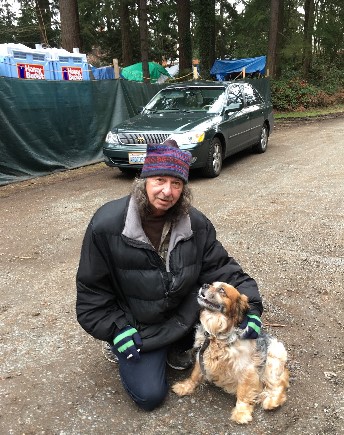
Before my visit, I told myself that I had no business at a homeless camp, and the people there would resent my presence. I’d thought that homeless people preferred to be invisible in our society, and steeled myself for hostility or at least indifference. Then I met Christopher, Tom, Monty, and Isaac. They welcomed me to the camp with kindness, and willingly posed for pictures after hearing that I was a new writer for GSC. I learned that just like everyone else, they want to be seen and heard and respected.
Isaac and Bowser, outside of Camp United We Stand
Cleaner Than You'd Think 
Everyone I met appeared as clean as people without a shower on premises could possibly be expected to look. The camp was well-maintained, orderly, and spotless. If I hadn’t known it was a homeless camp, I might’ve asked about the campground rates.

Some Problems are Small Enough to Fix 
Christopher was one of the three resident ECs (elected Executive Council member) that week, and in charge. When he showed me the Donation Tent, Christopher pointed out that they were short on men’s pants, sizes 30-39. They also needed a stapler before Move Day. I have an extra stapler at home. I had thought that if you help the homeless, you enable the homeless problem to continue. Greater Seattle Cares helped me see that people must have their basic needs of food, clothing, shelter, and safety met before they can even think about next steps to improve their lives.

Even Little Things Make a Difference 
Before volunteering as a writer for GSC, I worried that it would make me feel bad to know more about the homeless problem because it’s so big that I couldn’t make a difference. I learned that even little things make a difference. Listening to someone, and speaking with respect and warmth. Writing about real people in our community, who want to be seen and heard. I can do these things.