Navigation

Showing posts with label homelessness. Show all posts

Sunday, February 17, 2019

Please Help with Camp Unity's Move - March 1 and 2


It’s time again on March 1 and 2 to move Camp Unity Eastside!  We depend on volunteers like you to help us in packing, moving and setting up the community and personal tents, platforms, and camp supplies.  Won’t you join us?   It’s a great opportunity to meet and work along side men and women of the camp and other volunteers in the community.  See below for more info on ways to help with the move, needed supplies and meals.
Move Essentials
  • Current camp location: 17401 133rd Avenue NE, Woodinville.  Next to the Carol Edwards Center on the Woodinville City Hall campus
  • New camp location: St. Jude Parish, 10526 166th Avenue NE, Redmond

Day
Tentative Schedule and Logistics
Friday, March 1
8:30 am to 5 pm:  Planned start is at St. Jude Parish, Redmond.  Focus will be on unloading trucks and setting up community tents and platforms.
Saturday, March 2
8 am start, duration to be determined: Planned start is at the Woodinville site to pack up and move any remaining items and finish site clean-up, and then complete camp set up at St. Jude Parish site

Let Us Know You Can Join

We’ll update you on move logistics including updates for start times and locations

What to Bring
  • Wear clothes you don’t mind getting dirty, sturdy shoes, gloves, and rain gear if needed
  • Tools:  We need several cordless drills, Phillips head bit size #2 and fully charged batteries
  • Bring personal water and snacks.  Lunch will most likely be provided.
  • Trucks and trailers are greatly appreciated
  • Kids are welcome

Want to Help By Providing Supplies or a Meal?
  • Provide supplies from the needs list for the move such as zip ties, duct tape and work gloves.  Please bring donated supplies to Camp Unity in Woodinville by February 25.
  • Provide a breakfast, lunch or dinner during the move. Email Lori for more info if you can help.

Thank you for helping the men and women of Camp Unity in this tremendous way!

Friday, March 2, 2018

February 2018 Updates

What’s New?

Camp Moves

We are happy to report that Camp United We Stand has had their stay at St. Dunstan’s church in Shoreline extended until May. The will move to the Haller Lake United Methodist Church in August but are still searching for a host for May, June and July. Tent City 3 moved last weekend to a site owned by Cherry Hill Baptist Church in the old central district. Their new home has neither power nor water access, but we are grateful for it as the location was not found until the last minute before they were due to leave SPU and it had looked like they might not have a place to go.

What’s not new?

Site Searches

The camps we support have needs that are constant. Chiefly, they need a place to stay. The sanctioned camps we support typically, have to move every 90 days depending upon the type of permit needed for the host location. While the occasionally may be able to stay longer they typically have to find 4 hosts a year or risk having to move to an illegal location where they could be subject to being swept. The one constant need is space. Depending upon the size of the camp the amount of space needed can vary. Ideally the space should be fairly flat but even that is not an absolute requirement as we have seen tent bases adjusted to compensate for different sites. It is preferred they have access to power and water, but they have generators and water jugs if that is not the case. While Greater Seattle Cares does not manage host searches for any of the camps we do reassure prospective hosts that we will provide services to the camps assisting with food and supplies during their stay and if needed support with moving in or leaving. If you are aware of any church, school or private business that may be interested in becoming a host please contact the camp or SHARE WHEEL directly with your lead. 90 days may sound like a long time but the reality is that the search for host locations goes on constantly.

What are current needs?

Managing donations - When delivering items to camp please always take care not to overload them. While the campers are always grateful if the camp receives more than it can use it can create problems. Items stored in tents can become damp and moldy. If you are delivering to camp, always ask for the donation coordinator or for food donations, the kitchen coordinator. Ideally call ahead and check with the camp to ask them what is needed and how many people currently reside in camp. The camp phone numbers can be found on our website.
Food for the Pantry - GSC recently delivered some individual ready to eat foods to Tent City 3 as their pantry was almost completely wiped out after their move.
Water - When a camp doesn’t have water access they need bottled water or water jugs. Our recommendation is to fill the camps large water containers rather than supplying individual bottles of water. Individual plastic bottles create a lot of garbage that the camp then has to dispose.
Gas for the Generators - We assume Tent City 3 will be using generators at their current location. They typically need donations of gasoline to keep them going. We recommend picking up the gas cans and taking them to be filled as they are heavy to carry and the campers typically don’t have transportation. Last year when staying at Skyway GSC purchased gas for the camp on a weekly basis.
Tents and Tarps - A tent used year round only lasts about a year. Camps use what the call singles and doubles which can range in price from $50 to $150 each. The can also use tent carports for common use tents and like cabin style tents so someone can stand up inside. Tarps extend the life of the tents by protecting the seams and keep the tent much drier.
Coats and warm clothing - Any cold weather clothing we can provide, especially is a blessing this time of year. Keep in mind that a lot of campers are larger men. New undergarments are always appreciated.
Blankets and Bedding - Campers need bedding and the ability to wash it. Each camp has its own laundry arrangements, but they sometimes need assistance with obtaining these donations
Batteries -The short days mean more flashlights will be used and that means batteries. Especially for Tent City 3 as their new site does not have power.

Current Camp Hosts and Locations

Tent City 3 - Cherry Hill Baptist Church, 700 22nd Ave. Seattle, WA 98122
Tent City 4 - Mary Queen of Peace, 1121 228th Ave SE, Sammamish, WA 98075
Tent City 5 - Interbay Neighborhood in Ballard, 1601 15th Ave. W (cross street Garfield, under the Magnolia Bridge), Seattle, WA 98119
Camp Unity Eastside - Saint Teresa of Calcutta, 17856 NE Woodinville Duvall Rd, Woodinville WA 98077
Camp United We Stand - St. Dunstans Church, 722 N 145th St, Shoreline, WA 98133
Camp Second Chance - Public Property in White Center, 9625 Myers Way S. Seattle, WA 98108
Nicklesville Ballard - Public property in Ballard, NW Market Street, Seattle, WA
Nicklesville Othello - 7544 Martin Luther King Jr. Way, Seattle, WA
Nicklesville Union Tiny House Village - Lutheran Church of the Good Shepherd, 22nd and E Union, Seattle, WA
Nickelsville Georgetown - 1000 S. Myrtle St., Seattle, WA
Licton Springs Village - Private Property belonging to the Low Income Housing Institute, 8620 Aurora Ave N just south of Seattle Fabrics

Anatomy of a Camp Move:

Many of the camps we serve have to move about 4 times a year.  The move process takes a lot of planning, and hard work.  Imagine picking up everything you own, including your house and moving it across town every three months. 
Prior to a move, a camper with experience is designated as the “Move Master.” This person will coordinate all of the work involved with moving as well as gathering needed supplies.  GSC includes move supplies as a part of our budget. These can run about $400 per move and includes items like trash bags, zip ties, gorilla tape, and hammers, nails work gloves and brooms.  In some cases we have also rented vans and supplied a driver. Prior to the move, the move master will plot out the new camp layout to make sure everything needed will fit at the new site.  Before move day the camp may try to stage a few items at the new location. 
On move day there is a crew breaking down the camp at the old site and another stationed at the new site setting up.  All campers are required to participate in the move or will be barred for a time from the camp if they do not participate.  During the move trucks are loaded and as each arrives at the new camp site they are unpacked.
Common use tents such as the kitchen and Front Desk tents are set up prior to any individual tents.  The perimeter privacy screen is erected.  Usually dump runs are needed and if it is available electrical cords are set up to run the camp’s microwave and coffee maker.   Due to the physical work required with the moves GSC also tries to make extra sure there are meals provided in both locations. Volunteers and friends who want to help with the move are always welcome. Next time one of our camps move, we encourage stopping by to lend a hand.  While it appears our camps move in one day it really takes a good couple of weeks to get really settled.

Thank you!

Thank you for participating in the mission of Greater Seattle Cares. Thank you for caring! And thank you for your donations of money, time, goods, and relationships. Your caring brings hope and change to those we serve.

Wednesday, July 26, 2017

On a Mission

By Christy Houghton 
Christopher Carter
On a chilly Sunday morning last spring, I sat down with Christopher Carter, one of the residents at Camp United We Stand (CUWS). After graciously agreeing to the interview, he led me to the TV Tent so he could warm his hands by the heater while we talked.
Christopher has been an elected leader at the homeless camp, and speaks with sincerity and conviction. One of the first things I learn about him is that he’s on a personal mission.

“God Delivered Me from a Terrible Stutter” 

Christopher said he’d had a bad stutter for most of life. He worked in construction as a general contractor, building houses in Oklahoma. In 2013, a traveling evangelist sent him a text, telling him to read Jeremiah 33:3. At this point, Christopher paused, and I looked at him questioningly. He just repeated, “Jeremiah 33:3.” He went home and read the whole chapter.
When Christopher went to share what he'd read with his friend Theresa, she interrupted him, saying, "Christopher, you don't stutter no more." From that time on, Christopher says, “God delivered me from a terrible stutter, and has given me a beautiful voice.” It made his mother cry, when he first spoke to her without that stutter.
I didn’t learn what was in that Bible verse until I got home and looked it up. “Call to me and I will answer you and tell you great and unsearchable things you do not know.” – Jeremiah 33:3

He Needed to Go to Tent City 3 

In 2015 Christopher helped a friend of his move from Oklahoma to Arlington, Washington. From there, he felt called to go to Santa Monica, California. The police picked him up on the side of the Interstate, telling him that he couldn't walk down it. You can do that in some other states, but not in Washington. In Downtown Seattle, where the police dropped him off, Christopher had planned on getting a couple day’s work for a bus ticket to Santa Monica.
Someone he’d recently met at the Bread of Life Mission downtown interrupted a conversation with someone else not just once, but three separate times, to tell Christopher that he needed to go to Tent City 3. So, that’s what he did. "Years ago, I told the Father, if You need to use me or move me, give it to me in threes or sevens." Camp United We Stand was founded by Christopher and some others who were at Tent City 3.

“This is where God wants me.” 

Christopher would prefer living in permanent housing, but he says, "This is where God wants me." Drawing on his construction background, he recently designed a new type of shelter made from thick Styrofoam insulation material. These shelters, called BOBs (Built On Blessings), are easy to build, relatively inexpensive, and collapsible for moving. Once tarped, they’re warmer and drier than a tent.
Christopher has also been working on building a "bath house”, a foam structure with a real bath and shower using a donated tub. “The foam house is just a rest stop on my journey." Christopher has a bigger vision.

“Homelessness isn’t something that gets fixed, it needs to be healed.” 

Christopher says he never felt the need of the homeless while he was living in a house. He never felt it until he came here. “Homelessness isn't something that gets fixed, it needs to be healed. Permanent housing can help with that. If every church has housing structures, people who need a place to live can come to their local church instead of going downtown where the drugs are.” Christopher has a personal mission to talk with each church in the area, asking them to reserve part of their property for people in their community who become homeless. His vision is that each church, according to its size would have portable but permanent housing.
In the future, Christopher plans to keep going wherever he's led, to wherever he’s needed, to wherever his mission points.

NOTE: Since Christy’s interview with Christopher, he has left Camp United We Stand. Several of his BOBs, however, are still standing at the camp. If you are interested in seeing this innovative new structure, feel free to stop by to visit. You can find the camp’s current location at http://greaterseattlecares.org/encampments/location-hosts/.

Thursday, July 6, 2017

Speaking Up

By Christy Houghton

I signed up for Homeless Advocacy 101, a workshop sponsored by the Seattle/King County Coalition on Homelessness (SKCCH), to learn something new about helping the homeless. Geared towards ordinary people like me, who aren’t professional lobbyists and don’t remember much about American Government lessons from high school social studies, this free workshop was informative, interesting, entertaining – and sobering. On any given night in the Seattle area, 10,000 people are homeless, with 4,500 people still outside after shelters close. There is clearly a need for solutions.

Kate Baber, who works for the Washington Low-Income Housing Alliance, kicked off the workshop by reviewing some current legislative priorities which could benefit the homeless. But how to get our legislators to listen to our concerns about our neighbors who are without shelter?

That was the focus of Nancy Amidei’s talk. Nancy has influenced public policy for years in both Washigntons before retiring from teaching civics and advocacy at the University of Washington. She gave a short review of how our elected representatives work for us at the state and federal levels and the way that bills are turned into laws.

Nancy’s definition of advocacy is, “Speaking up!” Our government representatives have staff for facts. They need us for personal stories. Stories that are brief and compelling will help influence their colleagues on our behalf. One easy way to speak up is to call the Legislative Hotline at 1-800-562-6000. It’s a free call to a helpful person who will get your message to the right people. Nancy also advises signing up with a good advocacy group that's tracking the issues you care about and will inform its members about opportunities to act.

Alison Eisinger, SKCCH’s Executive Director, facilitated the workshop. Her goal, she told us, was to have us leave with tools, knowledge, and a sense of empowerment. I left with all of that, plus the conviction that I can make a difference by speaking up to share stories about the homeless with my elected representatives.

Resources:

Thursday, April 6, 2017

Ordinary people helping others

Recently Greater Seattle Cares volunteer David Baum did a radio interview with Mind over Matters of KEXP 90.3 FM.

David is the founder of his own non-profit called Rumblecrash, and in this article he talks about his work with homeless communities in Seattle.

Take a listen!


Monday, February 6, 2017

Homelessness Advocacy 101 Workshop

Seattle/King County Coalition on Homelessness is conducting workshops on Advocacy!


Per their website,

Our workshops are fun! We'll discuss the funding proposals for shelter, housing, and supportive services currently being considered and review the steps that everyone can take to make sure housing and homelessness concerns are prioritized in our local government. Nancy Amidei, an incomparable pro-democracy cheerleader, local policy experts, and Coalition staff will present details about 3-4 important issues. We'll provide you with simple actions, sample messages, and the chance to practice your skills. You will leave informed and inspired with tools for engaging your classmates, fellow congregants, neighbors and others to speak up and make a difference.

Dates are February 22, February 26, and March 5.

Registration is required, so head for their website and sign up!

Friday, September 30, 2016

From 1903 to 2016 -- what's changed?

Jack London, in 1903, wrote a book titled, "People of the Abyss."

You can find it here. It includes pictures -- black and white, but pictures -- of the deplorable conditions found there.

In over a hundred years, nothing much has changed. We still see the same conditions in many "civilized" countries, "modern" cities, and "technologically advanced" areas. Silicon Valley. The Bay Area. Greater Seattle.

Here's a quote...
Tenements spring up like magic, gardens are built upon, villas are divided and subdivided into many dwellings, and the black night of London settles down in a greasy pall.
Has anything really changed? The names, the faces, the locations...

But still, today, we have corporations, faceless entities, buying buildings that people less well-off can live in, and replacing them with 38-story skyrises -- where those same people cannot afford to live. This creates homelessness.

Hasn't changed a bit.

And the conditions of the ghettos haven't changed much either. Landlords still try to suck every last penny out of the pockets of their tenants. Even landlords ostensibly trying to do the right thing.

Perhaps we should do something about that. What, I'm not sure. But something.

Monday, August 22, 2016

Tent City 3 is moving!

Tent City 3 is moving, August 27, 2016, from St. Joseph's on Capitol Hill, to George Center for Community on 125th Street.

They're going to need help! Call 206-448-7889 or 206-399-0412 for more information or to volunteer. They may be starting to move stuff on Friday, August 26.

Friday, August 12, 2016

You don't need a home to vote.

I'm not sure this really needs explanation.

You don't need a home to vote.

Monday, April 25, 2016

Amazon gives Mary's Place a place... for a while.

The Seattle Times ran this story on April 13.

The story: "The tech giant will let Mary’s Place, a nonprofit dedicated to helping homeless women and their families, run a shelter housing more than 200 people for a year in a former Travelodge that it bought as part of its downtown Seattle expansion."

Amazon purchased a number of properties downtown as part of its expansion project. Some of these properties aren't scheduled for demolition or construction for years yet, and Amazon is making this one available to Mary's Place for about a year. When the year is over, there's another property right across the street they're planning to let them use for another span of time.

Other businesses have chipped in to help the project.

Read the rest of the story at the Seattle Times.

Wednesday, April 13, 2016

The State of Homelessness in America

The National Alliance to End Homelessness has issued its 2016 report on the State of Homelessness in America.  You can download it here.

Overall, homelessness in America decreased by 2%.

However, the number of people living "doubled up" has increased by 52% since 2007.

The number of people paying more than half their income for rent is up 2.1% nationally. Since 2007, this number has increased 27.7%. It has not decreased with economic recovery; the number has plateaued.

The national decrease in unsheltered homelessness was driven by large decreases in Florida, Texas, and Georgia. Unsheltered homelessness only decreased nationally by about 1800 people (from the graph on page 9 [page 11 of pdf]).

The national rate of homelessness was 17.7 per 10,000 people. Many states were below that, but a few (as well as the District of Columbia) were above (pp. 12-13).
  • Alaska 26.5
  • California 29.8
  • Colorado 18.6
  • Washington, DC 110.8
  • Florida 18.0
  • Hawaii 53.7
  • Maine 17.8
  • Massachusetts 31.3
  • Nevada 30.8
  • New York 44.7
  • Oregon 33.3
  • Vermont 24.3
  • Washington 27.5
The changes in unsheltered homelessness are startling. While nationally the rate decreased by 2.0%, in many states the number of unsheltered homeless rose starkly (map on page 16). Some of the more shocking figures:
  • South Dakota: 147% increase
  • Wyoming: 50% increase
  • Rhode Island: 80% increase
  • Illinois: 60% increase
  • Utah: 45% increase
  • Alaska: 119% increase
Just 18 states reported a decrease in unsheltered homelessness from 2014 to 2015.

The rest of the report is worth reading.

Friday, April 1, 2016

Camp Dearborn receives another eviction

Camp Dearborn is staying at 2314 E Spring St, at Umoja Fest Peace Center.
Yesterday, they and the primary tenant received a notice of eviction. A picture of it is shown (it's posted on the FaceBook page of the External Affairs Coordinator, Troy Morgan.

About Camp Dearborn

I stopped by their camp this afternoon, and they seemed fairly well organized. The camp was peaceful. I introduced myself, and asked a few questions.

So, Camp Dearborn, having split from Nickelsville, is still following somewhat of a Nickelsville model of governance structure, but not the Nickelsville model of governance style.

So, they have an Arbitrator, a Chief of Security, and an External Affairs Coordinator, elected by the camp.

They've decided that their rules are... not set in stone at the moment; they want some flexibility. So they've decided to call their rules "guidelines." So I asked the obvious question: What happens when someone refuses to follow the guidelines?

Their response: we'd bring it to the camp, democratically, and if the person refuses to follow the guidelines, we'd eventually have to kick them out.

So I asked about their needs. They said, "Water."

I could see, neatly stashed in a box, 5 empty gallon-sized water jugs. With about 20 people in camp, the need for water would be a no-brainer.

They probably also need food. I could see a propane grill, and they mentioned their meal calendar was bare. Which we can see after looking at it.

So, in 9 days they have to leave again. The City of Seattle seems to be stuck on repeating the past. This is approximately what happened with Tent City 3 16 years ago. They moved around a lot because the City of Seattle, despite the lip service it pays to "sheltering the homeless," doesn't seem to really like the homeless doing things for themselves.

Tuesday, March 22, 2016

SHARE's troubles

SHARE is having financial troubles again.

From sharewheel.org:
... although we have been working on this to get more funding our efforts have fallen on deaf ears. ...

Unfortunately, we have reached the point when we can no longer AFFORD TO STAY OPEN, literally. To date we have $70K in unpaid bills, our staff has been withholding their salaries, and we don’t have enough bus tickets to last thru the end of the month.

The Central Committee has MSP’d to have the last night be on March 30th, hopefully we’ll have enough bus tickets to last us until then. On March 31st we will be marching to the King County Administration Building Plaza and staying there until such a time that we can negotiate the needed funding in order to reopen our shelters. We hope many of you will join us because this is the only way we will be successful.

We have faced similar crisis in the past and by staying together we have managed to prevail. For over the 25 years we have had many victories through direct action. These we achieved by staying together and UNITED. Our strength is in our numbers. NOW is the time to show our strength as a COMMUNITY.
Further on in their website, they comment on the reason given for refusal of funding by King County:
SHARE has been hobbled with debt the past two years. We’ve still managed to keep people safe and alive. Now though, through funding cuts and general increases in operating costs, we can’t promise we will be able to keep going much longer.We simply can’t function without more stable funding.   In spite of this King County rejected our two funding proposal requests without consideration in late February. In one case, the reason for denial was because “King County does not consider Tent Cities to be shelters.”
Tell a backpacker, "a tent isn't shelter," and he'll laugh at you.
We must demand that King County follow their own emergency plan, and fund SHARE. King County says they follow the “All Home” Plan (to end Homelessness) but they don’t.  That Plan is clear – existing shelters like SHARE’s should be preserved, not bankrupted.
King County is incorrect about tent cities, and a judge in 2002 commented on this. Tents have a long and well-established track record as emergency shelter. They've been around for thousands of years, and they still work.

That's not the real reason, though. That's the "ostensible" reason, and since it's clearly false, there must be another -- unstated -- reason. We know that the Human Services people of both King County and Seattle act as though they utterly despise SHARE.

I agree that tent cities are not a solution to homelessness. They are not. You will not get any staffer at SHARE to agree that tent cities are a solution for homelessness. Tent cities are an interim survival mechanism -- as are all other homeless shelters. That's all they are. And an "interim solution," it seems to me, should be as cheap as possible, on the very grounds that it's not a permanent solution. We should be spending our money on permanent solutions, not on temporary ones, if we can at all avoid it.

Tent cities are one of the cheapest forms of shelter available. Even at $90k a year for 100 people, this is $2.50 per day per person. Tent cities don't have bedbugs (unlike the indoor shelters, which have them in profusion).  Yes, they are minimalist in terms of shelter. But there are reasons why many people use them. See my post on why people refuse shelter.

Tent cities are very visible reminders of homelessness.

And then there's this: if SHARE disappears by going bankrupt, will the Tent Cities disappear?

NO, they will NOT disappear. The tent cities of SHARE can operate without SHARE, and will if they need to.

Saturday, March 19, 2016

What do the homeless need most of all?

What's the Number One need of the homeless?

At a conference on March 11 in Tukwila, a number of leaders from cities around King County asked that question of three formerly homeless people.

And it's true that the homeless need Housing, and Jobs, and Shelter. Yes, they need those things. They need Showers, and they need Food.

But there are some things missing in that list.

Treat them with Dignity.

This is perhaps the single most important thing you can do. When you recognize that the homeless person you're looking at, the person you're trying to help, is a human being, and you treat them with the Dignity due every human being, something changes in your attitude, and something will change in theirs, too. Treat them with Dignity.

Include them in Community.

The homeless are citizens too. Include their opinions and respect their opinions when creating policy surrounding homelessness. They really are experts on their personal situation and why they're still stuck there. Include them in community.

Let them Participate.

Given the opportunity, most homeless people will seize it and make their own way out of homelessness. Seriously, this is the message that we see in all the data. For example, in Seattle, between a sixth and a quarter (the number depends on who you ask) of the homeless are chronic -- what man providers term "long-term stayers." But think about that. That means that three-quarters to five-sixths are getting themselves out of homelessness before they become long-term stayers! And, to be honest, the long-term stayers, given a reasonable opportunity to get off the streets... will seize it with both hands. So give them the opportunities, and let them participate in their own rehabilitation from homelessness.

Monday, March 14, 2016

Why Housing First?

Why Housing First?

Why do the supporters of Housing First believe that substance abuse should not be a bar to housing?
The Housing First model originated with a psychologist who discovered that people in housing stabilize more often than people not in housing. He discovered this before 1992, and his name is Sam Tsemberis1.

The Housing First model is really pretty simple:

...provide housing first, and then combine that housing with supportive treatment services in the areas of mental and physical health, substance abuse, education, and employment. Housing is provided in apartments scattered throughout a community. This "scattered site" model fosters a sense of home and self-determination, and it helps speed the reintegration of Pathways clients into the community.2

Pathways to Housing (Tsemberis’ organization) claims a housing retention rate of 85-90%.
Mentally ill and substance-abusing patients adhere to therapy better; tolerate housing better; and are less likely to commit crimes when housed.

Why?

Traditionally, the chronically homeless live in a cycle of surviving on the street, being admitted to hospitals, shelters, or jails and then going back to the street. The stress of surviving each day in this cycle puts a tremendous amount of pressure on the individual’s psychiatric and physical health. “Living in the street,” one Pathways to Housing client said, “It makes you crazy.”3

What’s different about the model, other than “put them in homes”?

The client participates in support services as long as they need them, but participation in a structured program is not a requirement for clients to keep their housing. Clients must only agree to meet with a member of their ACT team five times a month. Multi-disciplinary Assertive Community Treatment teams (ACT) provide clinical, vocational, and health services that are client-driven. These teams are available on-call 24 hours a day, seven days a week.4

Not every program that claims to be using “Housing First” really is using “Housing First.” This is a critical distinction. You can see from the above that the Housing First model means having support staff on-call 24/7. It means support is client-driven, not provider-driven.

We know that 88% of those who have housing in the “Housing First” model are likely to keep it. Only 47% of those not in that model are likely to keep it.

We know that the recidivism rate of former criminals is lower (by 71%) among those who are housed5. The study was conducted in Vancouver, B.C. Our own data over the last few years show this trend is real; the number of days spent in jail is reduced by 66%6 (6 months housed vs 6 months prior to housing).

The South King County pilot project7,8 showed a reduction in jail bookings (not the same as jail time), and drug and alcohol use was reduced.

Further, we know that Housing First, applied to the mentally ill and substance abusers, is cheaper than leaving them to live on the streets. This is seen in Utah, Florida, Seattle, Vancouver, Los Angeles. The amount saved per person housed depends on many variables, however. A Vancouver study, published in JAMA in 20159, found no difference in quality of life at 2 years, but substantial cost savings ($14k vs $22k, per person).

It is only common sense that the Housing first model could be appropriately applied to the disabled, the elderly, the infirm, and the chronically ill as well as to the mentally ill and to substance abusers. In a sense, the most vulnerable of the most vulnerable truly need the protection of homes. In addition, all of the homeless are experiencing degradation of their health. This is an inevitable result of living in the weather. And, to be honest, most of the homeless would be happy with substandard housing – it’s better than the streets, the tents, the cardboard boxes. They’d gladly accept a large waterproof box with a locking door, if they and they alone had the keys.

Footnotes:

Friday, March 11, 2016

Statistics about the homeless

In 2013, a report about homelessness was presented to the Bill and Melinda Gates Foundation. You can find a copy of it here. There's a pile of data in that report, and it's very interesting reading. I'm going to summarize some of it, because I understood more after reading it.

Understand, first, though, that these statistics don't necessarily show fault or causation.

They were searching for factors associated with homelessness. They often cite other studies for some interesting related statistics. Generally, I’ve limited statistics to whole numbers in the comparisons (they gave them to 1 decimal point).

5.6% are homeless; 6% of veterans are homeless.
2.8% are homeless again; 2.1% of homeless veterans are homeless again.

41% of homeless men and 83% of homeless women are parents.

30% of homeless report binge drinking in the last 30 days, vs. 16% of non-homeless.

20% of homeless scored 13+ on the Kessler Psychological Distress Scale, vs. 2% of non-homeless.

50% of homeless were unemployed, vs. 11% of non-homeless.

20% of homeless have no high school diploma, vs 6% of non-homeless.

41% of homeless have been incarcerated, vs 4% of non-homeless.

31% of homeless have fair or poor health, vs 13% of non-homeless.

Many homeless people have experienced an Adverse Childhood Event (ACE), and they've experienced more of them.

An ACE is defined as one or more of the following:
  1. Mental Illness in Household – Did you live with anyone who was depressed, mentally ill, or suicidal?
  2. Substance Abuse in Household – Did you live with anyone who was a problem drinker or alcoholic? Did you live with anyone who used illegal street drugs or who abused prescription medications?
  3. Incarcerated Household Member – Did you live with anyone who served time or was sentenced to serve time in a prison, jail, or other correctional facility?
  4. Parental Separation or Divorce – Were your parents separated or divorced?
  5. Parents Physically Aggressive Toward Each Other – How often did your parents or adults in your home ever slap, hit, kick, punch or beat each other up? (once or more versus never)
  6. Parents Physically Aggressive Toward You – Before age 18, how often did a parent or adult in your home ever hit, beat, kick, or physically hurt you in any way? Do not include spanking.
  7. Emotional Abuse – How often did a parent or adult in your home ever swear at you, insult you, or put you down? (once or more versus never)
  8. Sexual Abuse – How often did anyone at least 5 years older than you or an adult ever touch you sexually? (once or more versus never) How often did anyone at least 5 years older than you or an adult try to make you touch them sexually? (once or more versus never) How often did anyone at least 5 years older than you or an adult force you to have sex? (once or more versus never)

Indeed, for each of these experienced, a person is 40% more likely to become homeless. The average score for the homeless was 3.97; for non-homeless, 1.58. One-third of those with a score of 8 (the max) are homeless.

Here are some of the statistics (read the paper for the rest of them!):

58% of homeless have divorced/separated parents, vs 27% of non-homeless;
29% of homeless had an incarcerated household member, vs 6% of non-homeless;
52% of homeless have been struck or hit by parents (not counting spanking), vs 18% of non-homeless;
70% of homeless were emotionally abused by parents, vs 31% of non-homeless.


The numbers do tend to overwhelm somewhat, but step back and look at the patterns.

Causation?


Well, no. We can't show that with this data.

While it's true that 1/3 of those who scored 8 on the ACE are homeless, it's also true that 2/3 are not.
While it's true that 58% of homeless have divorced/separated parents, 42% do not.

What we do see are risk factors.

Just as smoking one cigarette may cause lung cancer, beating your children once may cause them to be homeless as adults.

Caveats

The report was created for the Bill and Melinda Gates Foundation, which has a long history of working to change some the behaviors this report indicates are associated with homelessness. I doubt the data is biased (after all, it's pure data). The choice of questions and topics may have been. 

And when you read the report, you will understand they did some "weighting" with their statistics, and I'm not sure I understand why. The raw data is not all presented, and does not seem to be easily available. I'm planning on asking for their tabulated survey data, stripped of identifying information.

There are questions they did not ask. Use of drugs, use of tobacco, experience with landlords, number of employers, length of last employment, time of last employment, and a few others. This seems to me to indicate a lack of understanding. However, the data they did acquire seems to be reasonable. I'm not sure I trust some of it, and I suspect a bias in the methodology. But it's a study, and the data is useful.

Wednesday, March 9, 2016

Homeless Student Stability and Opportunity Gap Act, HB-1682, passes.

From the Press Release by Columbia Legal Services:

HB-1682 will make Washington the first state in the nation to implement a new and innovative grant program to promote the creation of state-level school-housing partnerships.

"School is the one place that is likely to catch homeless children and youth early and help prevent chronic homelessness," said Rep. Jake Fey (D-Tacoma), lead sponsor of the bill in the House. "This bill is inspired by the McCarver Elementary School program in Tacoma. When the program works, a housing dollar can be considered an education dollar."

Read more here.

Saturday, March 5, 2016

Why do they refuse shelter?

Seattle reports that 60% of people in “unauthorized homeless camps” refuse shelter. A question many people ask is this: 


“Why don’t they go into shelter? Are they so addicted to drugs they’d rather have the drugs than sleep indoors?

I think that’s a good pair of questions, and they deserve a better answer than most are giving. The City of Seattle department heads, for example, don’t report why shelter is refused. They don't want to admit that their shelter system (or non-system) is inadequate for the needs of the homeless.

Let me ask a different set of questions, though, that may enlighten you as to why some homeless people refuse shelter:


Pets

If you were homeless, and the dog who’s been with you for 13 years was homeless with you, and you were offered shelter but the shelter prohibits pets, would you go into the shelter and abandon your best friend, your dog?
Spouses

If you and your wife were homeless, and the only shelter with beds available was for men only, would you go to the shelter and leave her outside to fend for herself?
PTSD

If you were homeless, and you had PTSD that was triggered by being around lots of people (shelters usually have lots of people), and you felt that you’d probably have a violent episode if you went to the shelter, would you go into the shelter knowing you were going to hurt people?
Bedbugs

If you were homeless, and you’d been in every shelter in the city, and gotten bedbugs at all of them, would you go back to any of them, knowing you’d be bitten again?
"Prohibited" Medications

If you were homeless, suffering from intractable pain for which you needed opiates or marijuana, and were prohibited from using those medications in the shelter, would you go, knowing you wouldn’t be able to sleep without your medication?
LGBTQIA...

If you were lesbian, gay, bisexual, or transgender, and the shelters offered had treated you badly because of your gender preferences, would you return to those shelters to be mistreated and possibly abused?
Children

If you were homeless with your children, successfully caring for them by working like mad, and to go into shelter you had to give them up, would you go into shelter and let your children fend for themselves in another one?
Compassion for others

If you were homeless, and if there were only two beds available, and others nearby on the street needed the beds worse than you, would you go?

I wouldn’t. Not in any of those situations.
Many homeless people I know wouldn't either.
Would you?

Sunday, February 21, 2016

Tent City 3 is moving March 5!

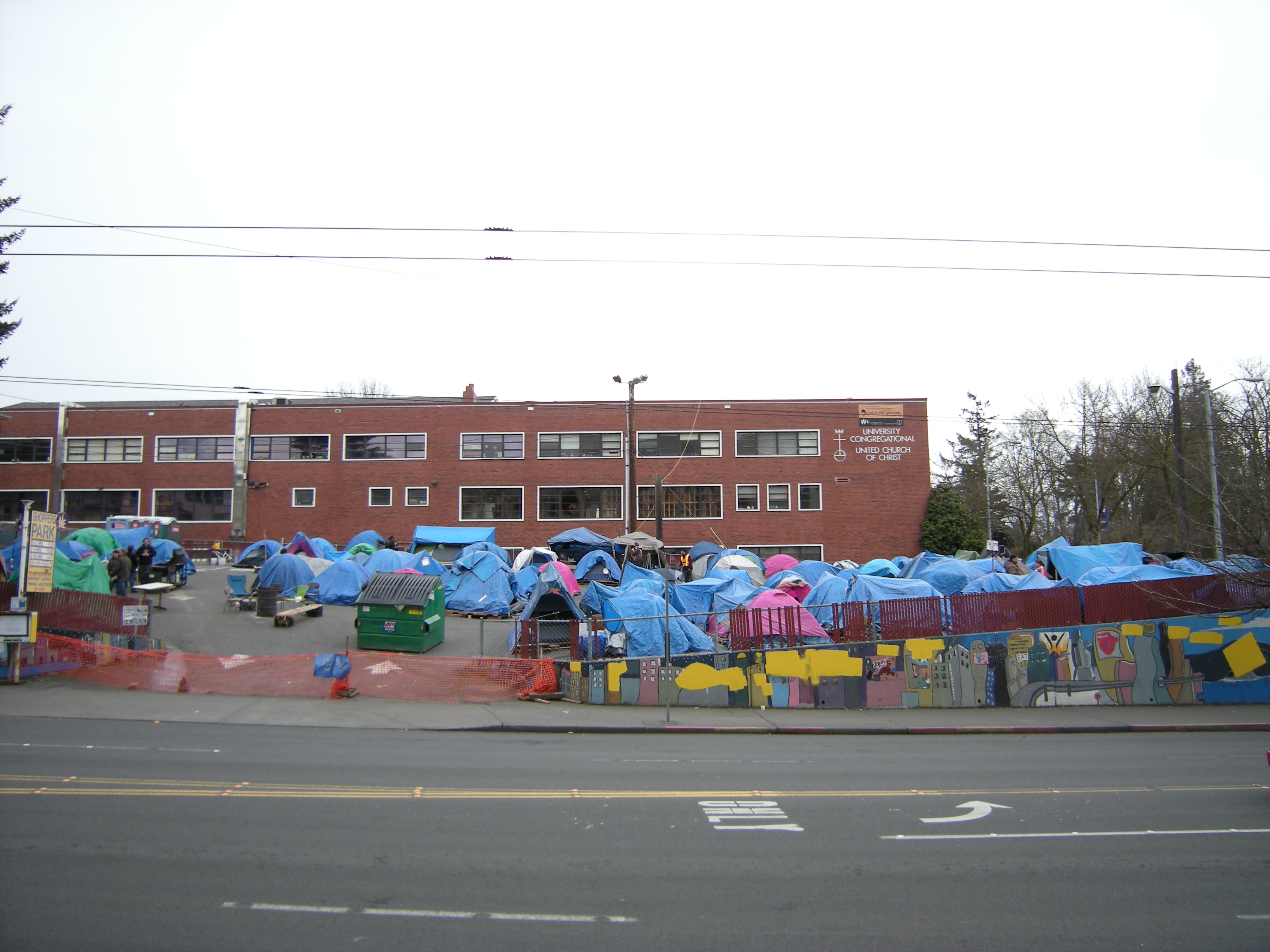
I hear from the residents of Tent City 3 that the camp has found a host for March 5 -- the University Congregational United Church of Christ, at 4515 16th Ave NE, Seattle, WA 98105.

Nickelsville at UCUCC, 2009
Nickelsville at UCC, 2009. Photo by Joe Mabel.
From wikimedia Commons.


The actual spot the camp expects to use is on the northeast corner of 45th and 15th. This spot was used by Nickelsville a couple of times, and by the Ave Foundation for a short period of time while Tent City 3 was at the Ravenna site.


The site is a bit smaller than their current site, and moving in will be somewhat difficult because of that. They will need help moving in, so volunteers will probably be welcome.

Call Tent City 3 at 206-399-0412 and speak to the movemaster for details about volunteering to help them move. People with trucks and vans, willing to haul stuff in them, will likely be welcome. SHARE usually rents a couple of large yellow trucks from Handy-Andy, but they can always use additional help.

Tent City 3 starts its moves at 8 am, and keeps going until everything is off the old site.

One other thing: moving in the rain is no fun at all, so pray for a sunny day for them.

Sunday, February 14, 2016

Medical help for the homeless

Many homeless do not receive medical help until it's too late. Many of them are afraid to seek medical help, for fear they'll become victims of untoward medical experiments, or they'll get so far along, and the doctor will deny care because of inability to pay.

Are you homeless? 

Do you live in poverty? 

Do you need medical help?


There are places and ways you can seek help for medical problems.

First, you likely qualify for Washington Apple Health. You should apply for it if you haven't already. If you go to any of the providers I mention below, they can help you apply. If you need a mailing address so they can send you a card, you can use General Delivery at Seattle's downtown Post Office (98101), or the Compass Center at 77 S. Washington (98104).

King County Public Health has several Mobile Medical vans; you can see their schedules on their website.

The City of Seattle is supposed to be funding a mobile medical van soon, but for now they're using King County's.

King County Public Health also operates several clinics; locations are listed on this webpage. Community health centers are listed here.

King County's clinics will not refuse service due to your inability to pay (they have a sign in their office that says that!). They will encourage you to apply for Washington Apple Health.


There are other medical clinics that will treat you for free, but you will have to apply for special consideration.

University of Washington Internal Medicine and Harborview. For each of those, you will need to apply for "Charity Care." You can read their policy on Charity Care here.  They did, at one time, have a zip code restriction on who could receive Charity Care, but that seems to have been lifted. At Harborview, there's an office to go physically apply for it.

Swedish also offers charity care. They gave away $35 million in services last year in direct charity care alone. And, I've heard good reports from those who've used Swedish.

There are other places you can seek help for medical issues, but these are some major ones in the Seattle area.

So find care, and get well.