Navigation

Friday, March 11, 2016

Drug addiction and homelessness

Are the homeless all drug addicts?


In 1989, 75% of a particular population group reported being addicted to drugs1. In 2003, the studies said 38% of the homeless regularly used drugs2

Of course, that’s 13 years ago, now. In 2007, two-thirds of homeless reported that substance abuse or alcohol abuse contributed to their becoming homeless3. On the street, substances are widely used, and when you’re on the street with them, it’s very hard to not use substances4.

It’s now 2016. Have things changed since 2009, when the National Coalition for the Homeless wrote about homelessness and drug addiction? Well… yes and no. According to the 2010 Annual Homeless Assessment Report to Congress (2010 AHAR), 26.2% of all sheltered persons who were homeless had a severe mental illness, and 34.7% of all sheltered adults who were homeless had chronic substance use issues. So, the answer would be, "No, it hasn't changed that much."

A relatively recent study, published in JAMA5, says that 17% of homeless deaths in Boston were due to drug overdoses. Around the Seattle area last year, the percentage was much higher. You can read the King County medical examiner’s report on homeless deaths here.

It’s not just a problem for the homeless, but for the entire population. 15% of the population uses drugs (or did in 20066).

And here’s the other thing to be aware of: the statistics change as the homeless population changes. In 2008, a veritable flood of homeless hit the streets because of the economic downturn. These were mostly normal people, dispossessed of homes by rampant greed. Most of them were not substance abusers, but some of them became substance abusers to escape the emotional and psychological trauma of having become homeless. Others became homeless because of their substance abuse and alcoholism.

Still, from my point of view, drugs and alcohol are scourges of the homeless population. Any group that addresses homelessness should be addressing drug and alcohol abuse among them.

Not all homeless abuse drugs and alcohol, but many do.

What is being done about the problem? Without stable housing, treatment is hard to seek. However, there are success stories out there. One person I know in the Seattle area has now been clean and sober for two years and counting. This is at least her third try. She is very persistent. But generally, fewer than 25% of homeless receive treatment for their substance abuse7.

That’s plain enough. What are the conditions that aid in recovery from substance abuse? These seem to be critical8:

  • Housing access. A stable living environment is a critical factor in recovery. Conditional housing that demands abstinence can cripple the recovery process.
  • Well-trained staff. Compassionate, flexible and patient care is required, whereas rigidity can break the recovery process.
  • Client-centered services. A tailored treatment plan usually provides a better pathway to recovery than establishing predesigned benchmarks that do not reflect the realities of the client’s circumstances.
  • Integrated services. Since the homeless often have co-occurring disorders, facilities that have multidisciplinary professional staff members can provide centralized treatment, which is preferable to a fragmented services model that has the client traveling between different centers.
  • Comprehensive services. Addressing the many needs of a homeless person, including survival and social needs, treats the problem of homelessness holistically rather than focusing on one part to the exclusion of other vital parts.

This appears to resemble the Housing First model:

Housing First provides access to mental health treatment. The client participates in support services as long as they need them, but participation in a structured program is not a requirement for clients to keep their housing. Clients must only agree to meet with a member of their ACT team five times a month. Multi-disciplinary Assertive Community Treatment teams (ACT) provide clinical, vocational, and health services that are client-driven. These teams are available on-call 24 hours a day, seven days a week. The team provides most services in the client’s “natural environment,” usually that person’s apartment, neighborhood, or workplace. Regardless of the treatment or service, staff members work collaboratively with each client to articulate goals as defined by the client and to help move that individual toward recovery and a full, meaningful life9.

Given all this, what’s the right thing to do?

Footnotes:
3 Didenko, E. and Pankratz, N. 2007. “Substance Use: Pathways to homelessness? Or a way of adapting to street life?” Visions: BC’s Mental Health and Addictions Journal, 4(1), 9-10. Available from http://www.heretohelp.bc.ca/.
4 Fisher, G.L., ed., and Roget, N.A., ed. Encyclopedia of Substance Abuse Prevention, Treatment, and Recovery. 2009. SAGE Publications, Inc.
6 National Household Survey on Drug Use and Health (NSDUH). “Drugs and Crime Facts: Drug use in the general population.” 2006. http://www.ojp.gov/bjs/dcf/du.htm.
7 “A Comprehensive Approach to Substance Abuse and Homelessness” (http://www.nhchc.org/wp-content/uploads/2012/02/hh-1003.pdf) (Oct. 2003). National Health Care for the Homeless Council. Accessed March 9, 2016.
8 Ibid.

Statistics about the homeless

In 2013, a report about homelessness was presented to the Bill and Melinda Gates Foundation. You can find a copy of it here. There's a pile of data in that report, and it's very interesting reading. I'm going to summarize some of it, because I understood more after reading it.

Understand, first, though, that these statistics don't necessarily show fault or causation.

They were searching for factors associated with homelessness. They often cite other studies for some interesting related statistics. Generally, I’ve limited statistics to whole numbers in the comparisons (they gave them to 1 decimal point).

5.6% are homeless; 6% of veterans are homeless.
2.8% are homeless again; 2.1% of homeless veterans are homeless again.

41% of homeless men and 83% of homeless women are parents.

30% of homeless report binge drinking in the last 30 days, vs. 16% of non-homeless.

20% of homeless scored 13+ on the Kessler Psychological Distress Scale, vs. 2% of non-homeless.

50% of homeless were unemployed, vs. 11% of non-homeless.

20% of homeless have no high school diploma, vs 6% of non-homeless.

41% of homeless have been incarcerated, vs 4% of non-homeless.

31% of homeless have fair or poor health, vs 13% of non-homeless.

Many homeless people have experienced an Adverse Childhood Event (ACE), and they've experienced more of them.

An ACE is defined as one or more of the following:
  1. Mental Illness in Household – Did you live with anyone who was depressed, mentally ill, or suicidal?
  2. Substance Abuse in Household – Did you live with anyone who was a problem drinker or alcoholic? Did you live with anyone who used illegal street drugs or who abused prescription medications?
  3. Incarcerated Household Member – Did you live with anyone who served time or was sentenced to serve time in a prison, jail, or other correctional facility?
  4. Parental Separation or Divorce – Were your parents separated or divorced?
  5. Parents Physically Aggressive Toward Each Other – How often did your parents or adults in your home ever slap, hit, kick, punch or beat each other up? (once or more versus never)
  6. Parents Physically Aggressive Toward You – Before age 18, how often did a parent or adult in your home ever hit, beat, kick, or physically hurt you in any way? Do not include spanking.
  7. Emotional Abuse – How often did a parent or adult in your home ever swear at you, insult you, or put you down? (once or more versus never)
  8. Sexual Abuse – How often did anyone at least 5 years older than you or an adult ever touch you sexually? (once or more versus never) How often did anyone at least 5 years older than you or an adult try to make you touch them sexually? (once or more versus never) How often did anyone at least 5 years older than you or an adult force you to have sex? (once or more versus never)

Indeed, for each of these experienced, a person is 40% more likely to become homeless. The average score for the homeless was 3.97; for non-homeless, 1.58. One-third of those with a score of 8 (the max) are homeless.

Here are some of the statistics (read the paper for the rest of them!):

58% of homeless have divorced/separated parents, vs 27% of non-homeless;
29% of homeless had an incarcerated household member, vs 6% of non-homeless;
52% of homeless have been struck or hit by parents (not counting spanking), vs 18% of non-homeless;
70% of homeless were emotionally abused by parents, vs 31% of non-homeless.


The numbers do tend to overwhelm somewhat, but step back and look at the patterns.

Causation?


Well, no. We can't show that with this data.

While it's true that 1/3 of those who scored 8 on the ACE are homeless, it's also true that 2/3 are not.
While it's true that 58% of homeless have divorced/separated parents, 42% do not.

What we do see are risk factors.

Just as smoking one cigarette may cause lung cancer, beating your children once may cause them to be homeless as adults.

Caveats

The report was created for the Bill and Melinda Gates Foundation, which has a long history of working to change some the behaviors this report indicates are associated with homelessness. I doubt the data is biased (after all, it's pure data). The choice of questions and topics may have been. 

And when you read the report, you will understand they did some "weighting" with their statistics, and I'm not sure I understand why. The raw data is not all presented, and does not seem to be easily available. I'm planning on asking for their tabulated survey data, stripped of identifying information.

There are questions they did not ask. Use of drugs, use of tobacco, experience with landlords, number of employers, length of last employment, time of last employment, and a few others. This seems to me to indicate a lack of understanding. However, the data they did acquire seems to be reasonable. I'm not sure I trust some of it, and I suspect a bias in the methodology. But it's a study, and the data is useful.

Wednesday, March 9, 2016

Homeless Student Stability and Opportunity Gap Act, HB-1682, passes.

From the Press Release by Columbia Legal Services:

HB-1682 will make Washington the first state in the nation to implement a new and innovative grant program to promote the creation of state-level school-housing partnerships.

"School is the one place that is likely to catch homeless children and youth early and help prevent chronic homelessness," said Rep. Jake Fey (D-Tacoma), lead sponsor of the bill in the House. "This bill is inspired by the McCarver Elementary School program in Tacoma. When the program works, a housing dollar can be considered an education dollar."

Read more here.

Saturday, March 5, 2016

Why do they refuse shelter?

Seattle reports that 60% of people in “unauthorized homeless camps” refuse shelter. A question many people ask is this: 


“Why don’t they go into shelter? Are they so addicted to drugs they’d rather have the drugs than sleep indoors?

I think that’s a good pair of questions, and they deserve a better answer than most are giving. The City of Seattle department heads, for example, don’t report why shelter is refused. They don't want to admit that their shelter system (or non-system) is inadequate for the needs of the homeless.

Let me ask a different set of questions, though, that may enlighten you as to why some homeless people refuse shelter:


Pets

If you were homeless, and the dog who’s been with you for 13 years was homeless with you, and you were offered shelter but the shelter prohibits pets, would you go into the shelter and abandon your best friend, your dog?
Spouses

If you and your wife were homeless, and the only shelter with beds available was for men only, would you go to the shelter and leave her outside to fend for herself?
PTSD

If you were homeless, and you had PTSD that was triggered by being around lots of people (shelters usually have lots of people), and you felt that you’d probably have a violent episode if you went to the shelter, would you go into the shelter knowing you were going to hurt people?
Bedbugs

If you were homeless, and you’d been in every shelter in the city, and gotten bedbugs at all of them, would you go back to any of them, knowing you’d be bitten again?
"Prohibited" Medications

If you were homeless, suffering from intractable pain for which you needed opiates or marijuana, and were prohibited from using those medications in the shelter, would you go, knowing you wouldn’t be able to sleep without your medication?
LGBTQIA...

If you were lesbian, gay, bisexual, or transgender, and the shelters offered had treated you badly because of your gender preferences, would you return to those shelters to be mistreated and possibly abused?
Children

If you were homeless with your children, successfully caring for them by working like mad, and to go into shelter you had to give them up, would you go into shelter and let your children fend for themselves in another one?
Compassion for others

If you were homeless, and if there were only two beds available, and others nearby on the street needed the beds worse than you, would you go?

I wouldn’t. Not in any of those situations.
Many homeless people I know wouldn't either.
Would you?

Sunday, February 21, 2016

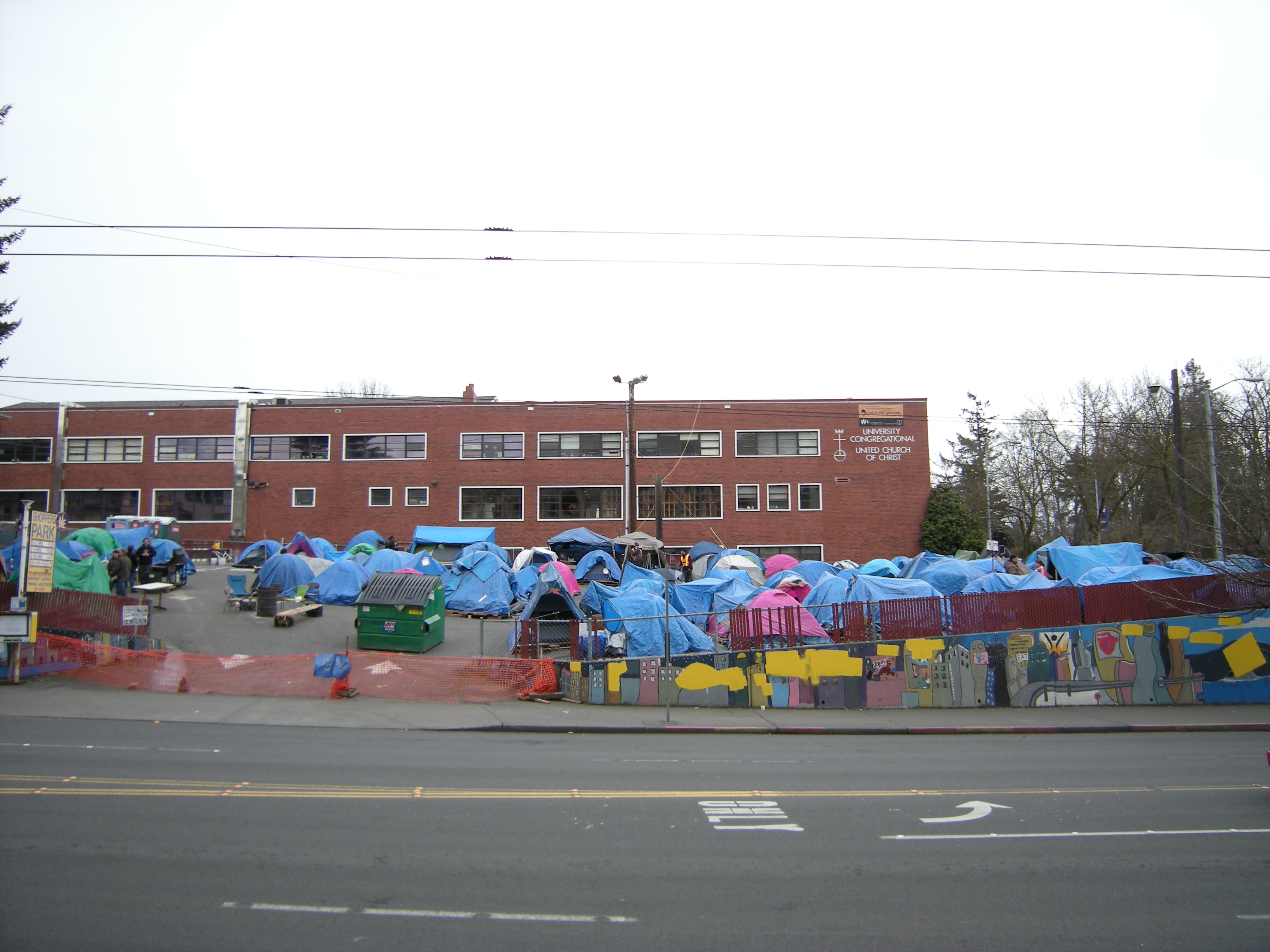
Tent City 3 is moving March 5!

I hear from the residents of Tent City 3 that the camp has found a host for March 5 -- the University Congregational United Church of Christ, at 4515 16th Ave NE, Seattle, WA 98105.

Nickelsville at UCUCC, 2009
Nickelsville at UCC, 2009. Photo by Joe Mabel.
From wikimedia Commons.


The actual spot the camp expects to use is on the northeast corner of 45th and 15th. This spot was used by Nickelsville a couple of times, and by the Ave Foundation for a short period of time while Tent City 3 was at the Ravenna site.


The site is a bit smaller than their current site, and moving in will be somewhat difficult because of that. They will need help moving in, so volunteers will probably be welcome.

Call Tent City 3 at 206-399-0412 and speak to the movemaster for details about volunteering to help them move. People with trucks and vans, willing to haul stuff in them, will likely be welcome. SHARE usually rents a couple of large yellow trucks from Handy-Andy, but they can always use additional help.

Tent City 3 starts its moves at 8 am, and keeps going until everything is off the old site.

One other thing: moving in the rain is no fun at all, so pray for a sunny day for them.

Sunday, February 14, 2016

Basic food?

The qualifications in King County for Basic Food recently changed.

Before January, 2016, anyone in the county below a certain income threshold could obtain food stamps.

After January, 2016, Able Bodied Adults Without Dependents (ABAWD) can only obtain 3 months of food stamps unless they are working, seeking work, disabled, or volunteering, or exempt for some other reason (pregnant, for example).

This has caused a rise in the number of people using food banks in the area.

Fortunately, there are ways for people who need food stamps, who are ABAWDs (nifty new acronym they coined), to qualify without having an actual job (for whatever reason). From the DSHS website:

ABAWD Work Programs

Workfare includes unpaid work in the community and participation in a BF E&T work program.
  1. Self-directed unpaid work in the community - ABAWDS can meet their work requirement by performing 16 hours a month of volunteer work for a non-profit organization.
    1. Workfare is unpaid work performed by an ABAWD for a public or private non-profit organization.
    2. An ABAWD may volunteer at any non-profit agency that agrees to provide volunteer work opportunities for ABAWDS to meet their work requirements.
    3. Non-profit agencies have agreed to verify that the person has met the 16-hour a month requirement for us not to count a month against the three-month limit. We will request verification of participation:
      1. At recertification; and
      2. Before issuing benefits beyond the three countable months.
    4. The workfare nonprofit agencies will notify us when a participant is no longer meeting the required hours.
There's a lot more at their website about this.

So: how many nonprofits need a bunch of poor and hungry (perhaps homeless) volunteers?

Medical help for the homeless

Many homeless do not receive medical help until it's too late. Many of them are afraid to seek medical help, for fear they'll become victims of untoward medical experiments, or they'll get so far along, and the doctor will deny care because of inability to pay.

Are you homeless? 

Do you live in poverty? 

Do you need medical help?


There are places and ways you can seek help for medical problems.

First, you likely qualify for Washington Apple Health. You should apply for it if you haven't already. If you go to any of the providers I mention below, they can help you apply. If you need a mailing address so they can send you a card, you can use General Delivery at Seattle's downtown Post Office (98101), or the Compass Center at 77 S. Washington (98104).

King County Public Health has several Mobile Medical vans; you can see their schedules on their website.

The City of Seattle is supposed to be funding a mobile medical van soon, but for now they're using King County's.

King County Public Health also operates several clinics; locations are listed on this webpage. Community health centers are listed here.

King County's clinics will not refuse service due to your inability to pay (they have a sign in their office that says that!). They will encourage you to apply for Washington Apple Health.


There are other medical clinics that will treat you for free, but you will have to apply for special consideration.

University of Washington Internal Medicine and Harborview. For each of those, you will need to apply for "Charity Care." You can read their policy on Charity Care here.  They did, at one time, have a zip code restriction on who could receive Charity Care, but that seems to have been lifted. At Harborview, there's an office to go physically apply for it.

Swedish also offers charity care. They gave away $35 million in services last year in direct charity care alone. And, I've heard good reports from those who've used Swedish.

There are other places you can seek help for medical issues, but these are some major ones in the Seattle area.

So find care, and get well.